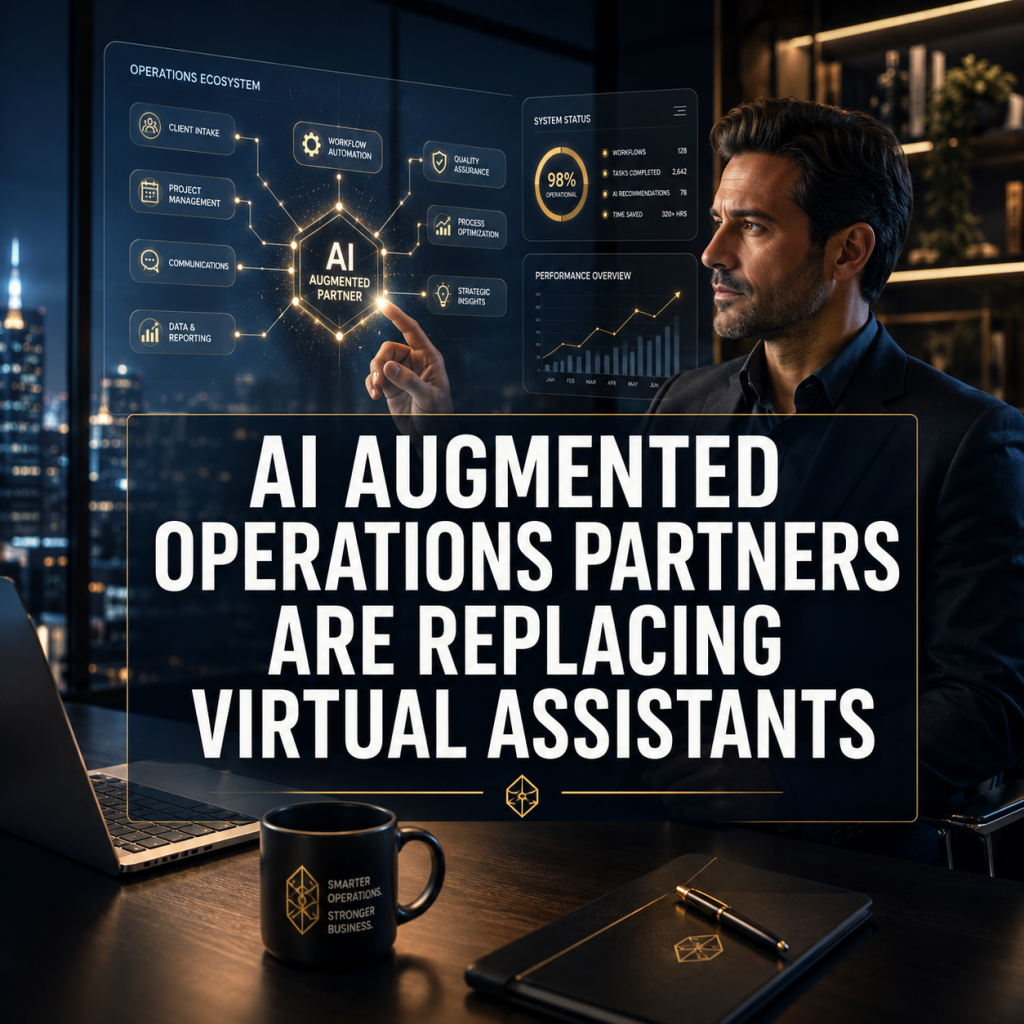
The role of the virtual assistant is being dismantled, and the replacement is already operational. A traditional virtual assistant waits for instructions. An AI Augmented Operations Partner anticipates, structures, and resolves operational friction before it reaches the founder’s desk. For entrepreneurs, coaches, and consultants drowning in disconnected tools and reactive workflows, this distinction is no longer academic. It defines whether a business scales or stalls.
Furthermore, the shift is structural. AI has changed what support work looks like, and the businesses still hiring task-doers are paying the price in lost capacity, fragmented systems, and inconsistent execution.
Key Takeaways
- Traditional virtual assistants execute tasks reactively; AI Augmented Operations Partners build proactive systems that prevent operational breakdowns.
- AI handles repetition and pattern recognition, but human judgment, context, and accountability remain irreplaceable.
- Neurodivergent founders benefit most from structured, AI-supported workflows that reduce cognitive load and decision fatigue.
- The future of executive support is not AI alone or humans alone. It is the integration of both inside a disciplined operational framework.
From Task Execution to Operational Intelligence
A traditional virtual assistant operates as a reactive human resource. They schedule, respond, and complete discrete tasks once instructed. However, this model worked when businesses ran on email and calendars. Today, however, It does not work when founders are managing CRMs, automation platforms, content pipelines, client portals, and AI tools simultaneously.
An AI Augmented Operations Partner functions differently. Unlike traditional assistants, AI Augmented Operations Partners integrate with the systems already in use, identify bottlenecks, and build workflows that prevent recurrence. Rather than waiting for instructions, they do not ask what needs to be done today. Instead, they build the structure that answers that question automatically.
This is the difference between hiring help and installing execution infrastructure.
Why AI Alone Cannot Replace Human Judgment
AI agents and assistants can summarize meetings, draft communications, and automate repetitive sequences. However, what they cannot do is interpret context, manage relationships, or take accountability for outcomes. A model does not know which client requires a softer escalation tone. It does not know when a deadline must shift because a stakeholder is in crisis.
In contrast, AI handles the repetition. Meanwhile, humans hold the judgment. Ultimately, Operations Partners hold the system together.
Therefore, this is why pure automation tools fail as standalone support. They require setup, oversight, and coordination. As a result, without a human execution layer, AI becomes another disconnected tool adding to the chaos. INVA practitioners are trained to operate AI as instrumentation, not as a replacement for structured human support.
Why This Matters for Neurodivergent Founders
Importantly, cognitive overload is not a productivity problem. It is an operational one. Founders with ADHD, autism, AuDHD, or executive functioning differences are often expected to adapt to workflows that were never designed for how they think.
An AI Augmented Operations Partner reverses that expectation. Instead, workflows are built around the founder’s capacity, not against it. For example, repetitive decisions are automated. Priorities are captured and surfaced at the right moment. Communication is structured to reduce ambiguity. Consequently, the result is a business that runs on systems, not willpower.
Therefore, this is the foundation of the INVA Accountability Partner Program and the broader neuroinclusive operations framework.
What Distinguishes an INVA Practitioner
| Capability | Traditional VA | AI Augmented Operations Partner |
|---|---|---|
| Task execution | Reactive | Proactive and systematized |
| AI integration | Minimal or none | Core competency |
| Systems thinking | Limited | Foundational |
| Neuroinclusive practice | Rare | Certified standard |
| Outcome orientation | Task completion | Operational stability |
Every INVA practitioner completes the Mastering Inclusive Support certification and demonstrates proficiency in our AI Augmented Operations Framework before being matched with clients. As a result, this combination is intentional. Inclusive practice without operational discipline produces inconsistency. Operational discipline without inclusive practice produces burnout. Both are required.
Learn more about how to partner with INVA or explore role-based support options.
Conclusion
The businesses that thrive in the next decade will not be those with the most tools. They will be those with the most coherent systems and the right partners to operate them. Traditional virtual assistance is a model built for a slower economy. It cannot absorb the operational complexity modern founders face.
The next step is structural. Audit where reactive task work is consuming founder capacity. Identify which workflows require systemization. Then engage an execution partner equipped to build and maintain them. To begin, contact INVA or review our operational pricing.
The future of executive support is already here. It is structured, AI-augmented, and human-led.
Frequently Asked Questions
1. Who should hire an AI Augmented Operations Partner?
AI Augmented Operations Partners are ideal for entrepreneurs, coaches, consultants, agency owners, executives, and growing businesses that need more than administrative support. They are particularly valuable for founders managing multiple clients, projects, systems, and AI tools while trying to scale without becoming the operational bottleneck.
2. What tasks can an AI Augmented Operations Partner actually handle?
An AI Augmented Operations Partner helps coordinate and improve business operations by managing workflows, documenting processes, organizing projects, supporting client onboarding, maintaining CRMs, coordinating communication, overseeing content pipelines, implementing accountability systems, and using AI to automate repetitive work. Their focus is not simply completing tasks but creating systems that make work more efficient over time.
3. Which AI and business tools do AI Augmented Operations Partners typically use?
Depending on the client’s workflow, AI Augmented Operations Partners may work with tools such as ChatGPT, Claude, Gemini, Perplexity, Notion, ClickUp, Asana, Trello, Slack, Google Workspace, Microsoft 365, Zapier, Make, HubSpot, Airtable, Calendly, Zoom, Canva, and CRM platforms. Rather than introducing unnecessary software, they help businesses make better use of the tools they already have.
4. What are the biggest benefits of working with an AI Augmented Operations Partner?
Businesses typically benefit from improved organization, reduced operational bottlenecks, clearer workflows, better accountability, less repetitive work, faster execution, and more consistent business operations. By combining AI with structured operational support, founders can spend more time making strategic decisions and less time managing daily administrative complexity.
5. How do AI Augmented Operations Partners support neurodivergent founders?
They design systems that reduce cognitive load instead of increasing it. This may include simplifying workflows, reducing unnecessary decisions, creating structured routines, improving communication, using AI to automate repetitive tasks, and building accountability systems that align with how neurodivergent founders naturally work.
6. What makes INVA’s AI Augmented Operations Partners different?
Every INVA Practitioner is trained in both operational systems and inclusive support through the Mastering Inclusive Support certification. This means clients receive professionals who understand AI-enabled workflows while also applying neuroinclusive practices, accountability, and systems thinking to create sustainable business operations—not just complete tasks.
7. Can an AI Augmented Operations Partner work alongside my existing team?
Yes. Many businesses use AI Augmented Operations Partners to strengthen their existing operations rather than replace employees. They often collaborate with founders, executive assistants, project managers, marketers, sales teams, and external contractors to improve coordination, document processes, and ensure work moves forward efficiently across the business.
8. How do I know if my business is ready for an AI Augmented Operations Partner?
Your business may be ready if you regularly experience operational bottlenecks, struggle to keep projects moving, manage too many disconnected tools, repeat the same instructions, or spend more time coordinating work than leading your business. These are common signs that stronger operational systems—not simply more effort—are needed.
9. Will an AI Augmented Operations Partner replace AI tools like ChatGPT or automation platforms?
No. AI Augmented Operations Partners enhance the value of these tools by implementing them strategically, maintaining the systems around them, and providing the human judgment, context, and accountability that AI cannot offer on its own. The goal is to create a reliable partnership between people, processes, and technology.
10. How can I get started with an INVA AI Augmented Operations Partner?
The process begins with understanding your current operational challenges, workflows, and business goals. INVA then matches you with an AI Augmented Operations Partner whose skills, experience, and working style align with your needs. From there, the focus shifts to building systems that reduce operational friction, improve execution, and support sustainable growth.
References
[1] The Human Advantage: How AI Is Forcing The Virtual Assistant To Become A Strategic Partner – https://medium.com/@sharonisicheri23/the-human-advantage-how-ai-is-forcing-the-virtual-assistant-to-become-a-strategic-partner-40cc976b472a
[2] AI Ops Partner vs Virtual Assistant for Founders – https://www.superintern.ai/blog/ai-ops-partner-vs-virtual-assistant-founders
[3] AI Agents vs AI Assistants – https://www.ibm.com/think/topics/ai-agents-vs-ai-assistants
[4] Why Founders Are Replacing Traditional VAs with AI-Augmented Operators – https://www.linkedin.com/pulse/why-founders-replacing-traditional-vas-ai-augmented-operators-aluoch-0fprf
[5] HRVA Partnership: How Virtual Assistants Support AI-Enabled Teams – https://www.linkedin.com/pulse/hrva-partnership-2026-how-virtual-assistants-support-ai-enabled-k-gnytc
[6] AI Agents vs Virtual Assistants – https://www.reddit.com/r/AI_Agents/comments/1r5cmf7/ai_agents_vs_virtual_assistants/
[7] AI-Augmented Virtual Assistants: Smart Staffing for SMBs – https://staffingsolutions.io/blogs/ai-augmented-virtual-assistants-smart-staffing-2025-smbs