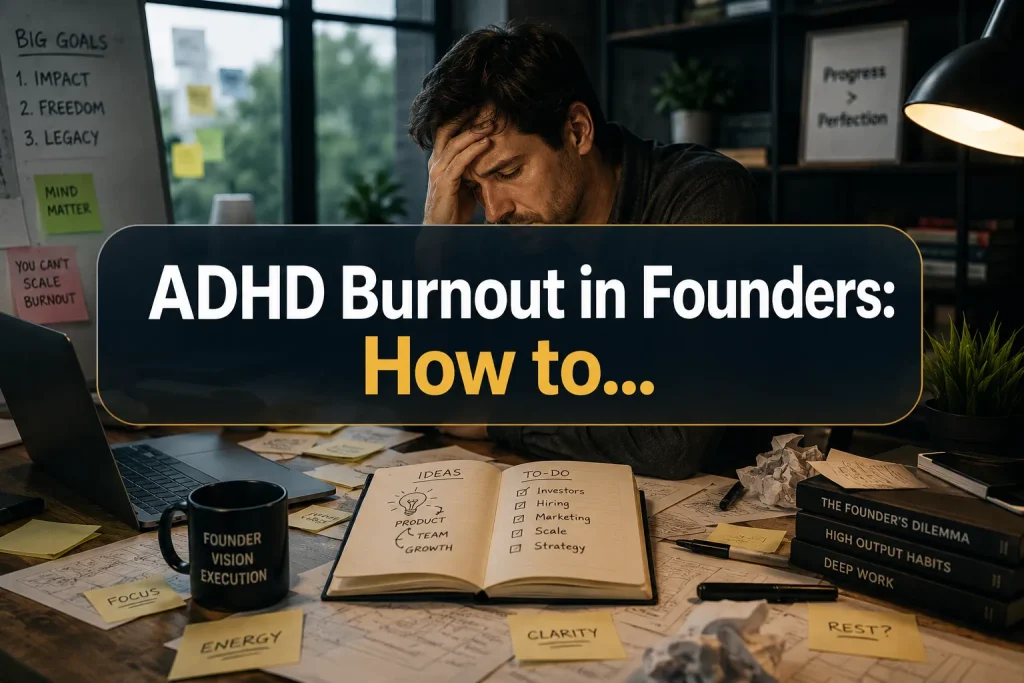
Sixty-eight percent of entrepreneurs report experiencing burnout at some point in their business journey, but for founders with ADHD, burnout is not simply the result of working too many hours. It is a neurological and emotional system crash, triggered by running on urgency, dopamine spikes, and stress hormones for extended periods without adequate structural support. ADHD burnout in founders is a distinct condition, and misidentifying it as ordinary fatigue leads to the wrong response every time.
Key Takeaways
- ADHD burnout is a neurological crash driven by sustained cognitive overload, not merely overwork or poor time management.
- Founders with ADHD are disproportionately vulnerable due to high-touch business models, identity fusion with their companies, and chronic decision fatigue.
- Recognisable signs include memory fog, emotional collapse, physical exhaustion, and a complete breakdown in executive function.
- Recovery requires structural change, not more discipline, more pressure, or more productivity hacks.
- External operational systems that reduce cognitive load, manage capacity, and create predictable rhythms are the most durable prevention mechanism.
What Is ADHD Burnout, And How Is It Different From Regular Burnout?
Standard burnout is typically described as chronic workplace stress that has not been adequately managed. ADHD burnout operates on a different mechanism entirely. It occurs when the ADHD nervous system, which relies on interest, urgency, and novelty to activate, has been running on stress hormones and external pressure for so long that the entire system shuts down.
What exhausts founders with ADHD is not workload volume alone. It is the constant low-grade demand on attention and emotional energy: the notifications, the reactive client requests, the context-switching, the invisible mental load of holding an entire operation in one’s head. When that system finally collapses, it does not look like tiredness. It looks like an inability to function.
Clinical indicators of this collapse include the body effectively “stopping”, difficulty getting out of bed or completing basic tasks, tasks feeling cumulatively more effortful than usual, and emotional resilience disintegrating so completely that ordinary stressors become overwhelming. This is not a motivation problem. It is a systems failure.
Why Founders With ADHD Are Especially Vulnerable
Several structural factors make neurodivergent entrepreneurs disproportionately susceptible to ADHD burnout.
High-touch business models, consulting, coaching, fractional services, and agencies, quietly exceed the brain’s sustainable capacity by creating constant client-driven urgency and reactive decision load. These models feel natural to ADHD founders because they generate novelty and stimulation, but they systematically erode the executive function reserves needed to sustain them.
Identity fusion compounds the problem significantly. Many founders tie their entire sense of self-worth to their company, which means that when capacity drops, it triggers panic rather than pragmatic adjustment. Rest feels like failure. Delegation feels like loss of control. The result is a founder who continues pushing past every warning signal until the system breaks.
Boundary erosion and emotional over-responsibility to clients and teams create a cycle of overcommitment, crisis, and attempted reinvention, a pattern well-documented among ADHD entrepreneurs. Burnout in this context is not a talent deficit. It is a structure and boundaries problem.
The uncomfortable reality, as current discussions among founders confirm, is that discipline cannot fix a broken operating system. When the bottleneck is the founder’s capacity, nervous system regulation, and ADHD patterns, adding more pressure accelerates collapse rather than preventing it.
Signs of ADHD Burnout in Entrepreneurs
Recognising ADHD burnout requires looking beyond surface-level fatigue. The following signs warrant immediate attention.
| Category | Warning Signs |
|---|---|
| Cognitive | Memory fog, missing meetings, forgetting deadlines, inability to initiate tasks |
| Emotional | Emotional dysregulation, disproportionate reactions, numbness, dread |
| Physical | Exhaustion unresolved by sleep, headaches, somatic tension |
| Operational | Missed follow-through, collapsed routines, avoidance of core business tasks |
| Relational | Withdrawal from clients, team, and support networks |
Memory fog, missing commitments that would previously have been automatic, is a particularly reliable indicator. So is the experience of tasks feeling cumulatively heavier, where activities that once required moderate effort now feel insurmountable.
Founders operating across neurodivergent business contexts should treat these signs as operational data, not personal failure. The system is communicating that current conditions are unsustainable.
How to Recover From ADHD Burnout Without Stopping Your Business
Recovery from ADHD burnout does not require dismantling the business. It requires redesigning the operating conditions that produced the burnout in the first place.
Step 1: Audit the actual cognitive load. Identify every source of reactive demand, client communications, decision points, context switches, and tasks held only in memory. Externalise everything into a visible system. Work that lives in the founder’s head is the primary driver of invisible overload.
Step 2: Redesign the business model’s demand structure. High-touch, client-driven models that generate constant urgency need structural modification, not harder effort within the same framework. This means reducing reactive touchpoints, batching decisions, and creating predictable operational rhythms.
Step 3: Establish capacity boundaries before committing to new work. The ADHD nervous system does not self-regulate workload effectively under pressure. An external mechanism, whether a structured accountability system or an operations partner, must monitor active commitments against realistic capacity.
Step 4: Rebuild executive function support externally. Body doubling, structured focus sessions, and accountability check-ins are not productivity luxuries. They are functional substitutes for the executive function infrastructure that burnout has temporarily depleted.
Step 5: Seek clinical support where indicated. When the body stops, emotional resilience collapses, and basic functioning is impaired, professional medical and psychological support is not optional, it is the appropriate next step.
How INVA Helps Founders Prevent and Recover From Burnout
INVA approaches ADHD burnout as an operational systems problem, not a motivation or resilience deficit. The framework is designed to eliminate the structural conditions that produce burnout, overload, decision fatigue, inconsistent execution, and invisible work, by building sustainable external systems around the founder.
Capacity management is the first line of prevention. Rather than encouraging founders to absorb more, INVA measures workload against actual capacity. When commitments exceed sustainable limits, the Accountability Partner works with the founder to reduce scope, extend timelines, or reprioritise, before the system breaks, not after.
Decision fatigue reduction removes the constant stream of micro-decisions that exhaust the ADHD nervous system. Instead of repeatedly asking what to work on, where to start, or what matters most, founders receive ongoing priority clarification, task breakdown, and execution planning through structured accountability support.
Predictable operational rhythms replace chaos-driven productivity. Morning planning, live accountability sessions, daily check-ins, end-of-day reflections, and weekly reviews create the consistency that the ADHD nervous system requires to sustain execution without relying on urgency or stress as activation mechanisms.
Executive function support, including brain-dump organisation, context-switching assistance, and distraction-resistant workflow design, externalises the cognitive infrastructure that burnout has eroded. Founders stop carrying the entire operation in their heads. Neuro-inclusive operations support makes this practical and sustainable.
For founders exploring what structured support looks like in practice, the INVA services overview outlines how Accountability Support, General Support, and Role-Based Support are structured to meet different operational needs.
FAQ: ADHD Burnout and Business
Is ADHD burnout the same as depression? They share overlapping symptoms, low energy, withdrawal, difficulty functioning, but ADHD burnout is specifically triggered by sustained cognitive and emotional overload in the context of executive dysfunction. Clinical assessment is required to distinguish them accurately.
Can a founder recover from ADHD burnout while continuing to run their business? Yes, provided the operating conditions change. Continuing with the same structure that produced burnout while expecting different results is not a recovery strategy. Structural modification, reduced reactive load, external execution support, capacity management, is the mechanism of recovery.
How long does ADHD burnout recovery take? Duration varies depending on severity, the presence of clinical support, and whether structural changes are implemented. Without structural change, recovery is temporary. With it, founders build sustainable systems that prevent recurrence.
What is the first operational step after recognising ADHD burnout? Externalise everything currently held in memory. Tasks, commitments, deadlines, and decisions must move out of the founder’s head and into a visible system. This single step reduces cognitive load immediately and creates the visibility needed to make rational capacity decisions.
Conclusion
ADHD burnout in founders is not a character flaw, a discipline problem, or an inevitable cost of entrepreneurship. It is a predictable outcome of running a high-demand business without the operational infrastructure to match the neurological reality of the ADHD brain.
The path forward is structural, not motivational. Here is the plan:
- Identify and externalise every source of invisible cognitive load.
- Audit the business model for reactive demand and redesign where necessary.
- Implement external capacity management before overcommitment becomes crisis.
- Build predictable operational rhythms that replace urgency-driven activation.
- Engage clinical support if functional capacity has significantly deteriorated.
Sustainable execution is not the result of working harder within a broken system. It is the result of building a system that works. For founders ready to stabilise operations and build the infrastructure that prevents burnout from recurring, explore INVA’s neuroinclusive operations support, or review what to look for in an inclusive operations partner before taking the next step.
References
[1] Watch – https://www.youtube.com/watch?v=YHvDfx72yf0
[2] Adhd Burnout Entrepreneurs – https://adhd-founder.com/blog/adhd-burnout-entrepreneurs/
[3] Founder Burnout Why Discipline Cannot 338930604 – https://www.iheart.com/podcast/269-be-known-online-podcast-sc-282873077/episode/founder-burnout-why-discipline-cannot-338930604/
[4] Id1586240372 – https://podcasts.apple.com/se/podcast/adhd-entrepreneur-upheaval-burnout-boundaries-and/id1586240372?i=1000776113684
[5] Watch – https://www.youtube.com/watch?v=F12uCdUoh2Y
[6] Watch – https://www.youtube.com/watch?v=qWkdRlW5eYs
[7] Adhd Founders Unfiltered – https://music.amazon.com/es-co/podcasts/ab6ac302-b16c-4b6c-93f5-0759a2770dc9/adhd-founders-unfiltered