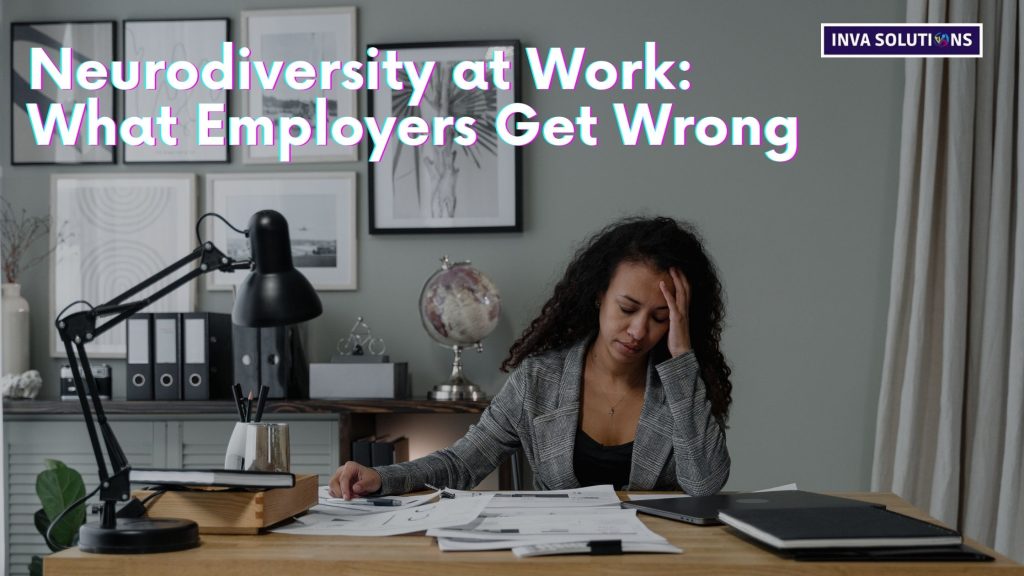
Many organizations claim to support neurodiversity, yet most fail to implement systems that make it work. From surface-level awareness campaigns to occasional accommodations, employers often approach neurodiversity with good intentions but flawed execution. Talented employees feel misunderstood, and leaders feel unsure how to provide meaningful support.
Neurodiversity at work is not a trend or compliance checkbox it’s an operational reality. When systems aren’t designed for different cognitive styles, performance suffers across the organization.
Ready to strengthen how your workplace supports diverse minds? Explore neurodiversity training for companies.
Mistake 1: Treating Neurodiversity as an HR Issue Instead of an Operational One
One of the biggest misconceptions is that neurodiversity belongs solely in HR or DEI discussions.
In reality, neurodiversity affects how work gets done:
- Task assignment
- Communication flow
- Deadline management
- Performance measurement
- Meetings and collaboration
When support is limited to policy statements or awareness events, employees still struggle inside systems never designed for cognitive variety.
Organizations ready to operationalize inclusion can start with inclusive workplace consulting services.
Mistake 2: Over-Focusing on Labels Instead of Work Design
Employers often focus on diagnoses instead of practical adjustments, asking:
- Who has ADHD?
- Who is autistic?
- Who needs accommodations?
The better question is: what work structures help people perform at their best?
Key improvements include:
- Clear task ownership
- Written follow-ups after meetings
- Flexible communication methods
- Defined priorities
- Reduced ambiguity
These adjustments benefit all employees. Inclusion should not rely on disclosure, it should be built into team operations.
Mistake 3: Confusing Flexibility with Lower Standards
There’s a myth that supporting neurodivergent employees means lowering expectations. The opposite is true.
Clear expectations combined with support structures strengthen accountability. Examples include:
- Structured deadlines instead of vague timeframes
- Asynchronous updates instead of mandatory live meetings
- Written instructions alongside verbal ones
Structured operational support, including inclusive virtual assistant services, reinforces accountability while protecting focus.
Mistake 4: Ignoring Executive Function Challenges
High-performing professionals often struggle with executive function demands, especially in fast-paced environments.
Challenges include:
- Task initiation
- Prioritization
- Time estimation
- Context switching
- Information overload
Ignoring these challenges leads employers to misinterpret struggles as laziness or lack of commitment.
Supportive tools such as structured accountability, clear workflow systems, and body doubling for sustained focus can unlock significant productivity gains.
Mistake 5: Treating Neurodiversity as a Niche Concern
Neurodivergent professionals exist across industries, seniority levels, and geographies:
- Founders
- Managers
- Executives
- Creative leads
- Operations specialists
Treating neurodiversity as a small subgroup issue underestimates its impact on innovation, retention, and leadership pipelines.
Organizations operating internationally or remotely can strengthen inclusion through the inclusive remote work movement.
The Real Cost of Getting It Wrong
Misunderstanding neurodiversity has tangible consequences:
- Increased burnout
- Disengaged high-potential employees
- Rising turnover
- Communication breakdowns
- Inconsistent performance
These are system design failures, not personality problems. Inclusive workplaces are built intentionally, with frameworks, leadership alignment, and operational support.
Moving from Awareness to Action
To support neurodiversity effectively:
- Audit communication structures and meeting norms
- Clarify role expectations and decision-making processes
- Build written documentation systems
- Train leaders on cognitive differences and bias
- Embed structured accountability into workflows
- Measure performance improvements alongside employee wellbeing
Neurodiversity at work isn’t just about accommodation, it’s about designing environments where different minds thrive.
For practical support, explore book inclusive virtual assistant services for your team and create a workplace where all employees do their best work.
Frequently Asked Questions
What is neurodiversity in the workplace?
Neurodiversity in the workplace recognizes that people think, learn, communicate, and solve problems differently. It includes individuals with ADHD, autism, dyslexia, dyspraxia, Tourette syndrome, and other cognitive differences. A neuro-inclusive workplace creates systems that enable these diverse strengths to contribute effectively.
What are the biggest mistakes employers make when supporting neurodivergent employees?
Many organizations focus only on awareness campaigns or accommodations instead of improving how work is designed. Common mistakes include unclear communication, inconsistent expectations, inflexible workflows, excessive meetings, and performance systems that increase cognitive load rather than reduce it.
How can employers create a more neuro-inclusive workplace?
Organizations can improve neuro-inclusion by establishing clear communication practices, documenting workflows, providing flexible ways to work, reducing unnecessary meetings, training managers, and designing operational systems that support different thinking styles while maintaining high performance.
What workplace tools help support neurodiverse teams?
Many organizations use platforms such as Microsoft Teams, Slack, Google Workspace, Asana, Notion, ClickUp, Monday.com, and Zoom to improve communication and collaboration. For businesses looking to simplify operations further, INVA often recommends GoHighLevel because it centralizes communication, CRM, workflows, automation, calendars, and client management into one platform, reducing operational complexity and helping teams work more consistently.
Why is workplace design more important than workplace accommodations?
Accommodations support individual employees, while workplace design improves the experience for everyone. Clear processes, structured communication, predictable workflows, and reduced ambiguity create environments where both neurodivergent and neurotypical employees can perform at their best.
Can neuro-inclusive workplaces improve business performance?
Yes. Organizations that invest in neuro-inclusive systems often experience stronger employee engagement, improved collaboration, better retention, increased innovation, and more consistent operational performance. Inclusive workplaces benefit both people and business outcomes.
How can INVA help organizations build neuro-inclusive operations?
INVA helps organizations move beyond awareness by designing practical operational systems that support diverse ways of working. Through workplace consulting, neuro-inclusive training, AI-augmented executive support, operational workflow design, and accountability systems, we help businesses build environments where inclusion becomes part of everyday operations.
Which organizations benefit most from neuro-inclusive workplace strategies?
Neuro-inclusive workplace strategies benefit businesses of all sizes, including startups, SMEs, corporations, nonprofits, remote-first organizations, educational institutions, healthcare providers, and professional service firms that want to strengthen both employee wellbeing and organizational performance.
Is neurodiversity only relevant for HR teams?
No. Neurodiversity affects every part of an organization, including leadership, operations, communication, recruitment, performance management, customer service, and team collaboration. Creating an inclusive workplace requires involvement across the entire business, not just the HR department.
What is the first step toward improving neurodiversity at work?
Begin by reviewing how work is currently designed. Evaluate communication methods, meeting culture, task management, leadership practices, and workflow structures to identify unnecessary cognitive barriers. From there, implement practical operational improvements that support both employee success and long-term business performance.