Roughly 35% of UK founders are dyslexic — more than three times the rate in the general population. That single data point reframes the conversation entirely. Neurodivergent founders are not an edge case in UK entrepreneurship. They are shaping how teams are built, managed, and scaled. Yet the systems most businesses default to were never designed with their cognitive profiles in mind. The result? Coordination stress that compounds as teams grow. Team efficiency support for neurodivergent founders UK is not a niche accommodation. It is a strategic operational priority.
Key Takeaways
-
Neurodivergent founders who implement structured systems outperform those who rely on ad-hoc coordination.
-
The primary bottleneck is rarely team skill — it is workflow clarity and decision overload
-
Five core operational systems can stabilize small teams and reduce cognitive load significantly
-
Human operations partners, not just tools, create the execution buffer that translates founder vision into reliable team output.
-
Structured support is available, scalable, and produces measurable results for UK-based founders
If Managing Your Team Feels Mentally Draining, This Will Sound Familiar
The pattern is consistent across neurodivergent-led teams:
-
The same questions get answered repeatedly
-
Tasks stall because ownership is unclear
-
Communication feels constant but progress feels slow
-
More time is spent coordinating than leading
-
Decision fatigue sets in before noon
This is not a leadership failure. It is a workflow clarity problem — and workflow clarity is fixable.
A 2024 study of 1,161 early-stage European ventures found that startups with at least one neurodivergent founder demonstrated higher team performance and more efficient coordination, particularly when deliberate process design was in place. The differentiator was not talent. It was structure.
The Real Constraint Is Not Team Size. It Is Decision Overload.
Neurodivergent founders — particularly those with ADHD or autism — often excel at systems thinking, pattern recognition, and big-picture strategy. The friction emerges in the operational middle layer: translating vision into repeatable daily execution.
“The solution is not more meetings. The solution is predictable systems.”
Research consistently shows that autistic and ADHD founders who build documented workflows and clear delegation structures turn what appears to be chaos into competitive advantage. Forbes profiled ten neurodivergent founders in early 2026, identifying a shared operational pattern: they productize their own coping mechanisms into team systems — time-boxed sprints, written SOPs, asynchronous communication defaults, and automation to reduce context switching.
This is not workaround behaviour. It is precision operations design.
Explore how inclusive virtual assistant services improve team performance for neurodivergent-led businesses.
The Team Efficiency Playbook: Five Systems That Stabilize Small Teams
These are not management theories. These are operational systems that reduce confusion, protect mental energy, and create predictable execution.
System 1 — Weekly Alignment
• Element: Detail
• Setup time: ~1 hour
• Format: Asynchronous written update
• Frequency: Weekly
• Outcome: Consistent team alignment without meeting fatigue
Process: Record short weekly priorities. Share blockers early. Eliminate the need for status-check interruptions.
System 2 — Delegation Clarity
Unclear ownership is the single biggest source of team coordination stress for neurodivergent founders.
Process:
-
Assign explicit task ownership — one name per task
-
Categorize by priority tier
-
Attach deadlines at the point of delegation
Outcome: Faster execution. Fewer repeated questions. Reduced decision load on the founder.
System 3 — Tool Integration
Scattered communication across email, WhatsApp, Slack, and spreadsheets is a cognitive load multiplier.
Process:
-
Centralize tasks in one project management platform (Trello, Asana, or Notion)
-
Standardize communication channels by task type
-
Track progress visibly
Hatch Enterprise’s 2025–26 programme for disabled and neurodivergent founders specifically trains participants in these platforms to convert ad-hoc collaboration into trackable pipelines.
System 4 — Continuous Learning Loop
Purpose: Improve team capability gradually without overwhelming the founder.
Process: Share one workflow improvement per week. Review recurring friction points. Build institutional knowledge into documented SOPs.
System 5 — Visibility Dashboard
Purpose: Real-time operational clarity without constant check-ins.
Process: Track workload distribution. Monitor task completion rates. Identify bottlenecks before they become crises.
Jill Corbyn, founder of UK-based Neurodiverse Connection CIC, uses “traffic-light” workload boards to prevent team overload — a system that has demonstrably reduced miscommunication and last-minute crises for autistic and ADHD staff.
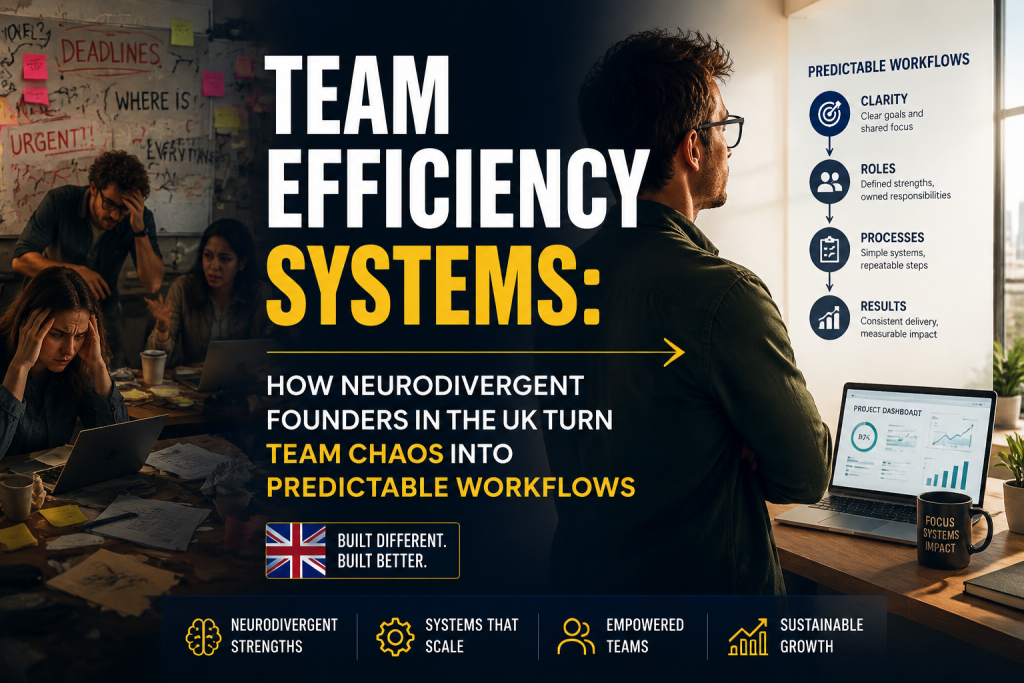
What a Stabilized Team Looks Like
Before Structured Support
- Tasks scattered across tools.
- Constant clarification requests.
- Delayed project delivery.
- Founder in coordination mode.
- Reactive firefighting.
After Structured Support
- Centralized task ownership.
- Clear delegation with defined deadlines.
- Reliable progress tracking.
- Founder in leadership mode.
- Predictable, energy aware workflows.
This is operational stability — and it is achievable without scaling headcount.
The Hybrid Advantage: These Systems Work Anywhere
Whether the team operates in-office, remotely, or across time zones, the same principles apply:
-
Structure reduces friction
-
Clarity protects focus
-
Consistency builds momentum
UK neurodivergent founder communities increasingly recommend pairing these systems with a detail-oriented human operations partner — not just AI tools — to create the execution buffer that translates rapid-fire ideas into structured, trackable tasks. This is the model that role-based operations support is built around.
Successful UK neurodivergent entrepreneurs including Sir Richard Branson and Kanya King have consistently appointed strong integrator roles and implemented rigid decision-making systems to translate founder vision into repeatable team processes. The pattern is not coincidence. It is deliberate operational architecture.
The Team Capacity Check for Neurodivergent Founders
Answer honestly:
-
Team members frequently ask for clarification on tasks
-
Delays occur because responsibility is unclear
-
Most of the day is spent coordinating rather than leading
-
Communication channels feel overwhelming
-
Managing the team causes consistent mental fatigue
If three or more apply, team workflow stabilization is the next operational priority.
Learn more about neurodiversity at work and what structured support looks like in practice.
What Happens During the 15-Minute Workflow Review
This is not a sales call. It is an operational diagnostic.
The session covers:
-
The biggest coordination bottleneck currently slowing the team
-
Where responsibility and ownership are unclear
-
The fastest single stabilization step available
Time required: 15 minutes
Outcome: A clear, actionable team efficiency plan
Book your workflow review and leave with a structured next step.
Conclusion: Make One Commitment This Week
Chaos in a small team is not inevitable. It is the result of missing systems — and systems can be built.
Here is the plan:
-
Choose one workflow to clarify this week
-
Assign explicit ownership to every open task
-
Centralize team communication in one platform
-
Schedule a weekly asynchronous alignment update
That single decision reduces confusion immediately. Momentum begins with clarity.
For neurodivergent founders navigating executive dysfunction, fluctuating capacity, or cognitive overload, the answer is not to work harder. It is to build an operational infrastructure that works without requiring heroic effort every day.
Explore INVA’s neuroinclusive operations support and see how structured team efficiency support for neurodivergent founders UK translates into predictable, scalable execution.
Frequently Asked Questions
What are team efficiency systems?
Team efficiency systems are structured processes that help teams work more consistently and with less confusion. They include clear delegation, documented workflows, centralized task management, regular communication, and defined responsibilities that improve collaboration and productivity.
Why do neurodivergent founders benefit from structured team systems?
Neurodivergent founders often excel at strategic thinking but can experience cognitive overload when managing constant coordination. Structured team systems reduce decision fatigue, improve workflow clarity, and allow founders to focus on leadership rather than daily operational firefighting.
What causes team inefficiency in growing businesses?
Team inefficiency is often caused by unclear task ownership, inconsistent communication, scattered information, duplicated work, and a lack of documented processes. As businesses grow, these issues create delays, increase mental workload, and reduce overall productivity.
What tools help improve team efficiency?
Many businesses improve team efficiency using tools such as Asana, Trello, Notion, ClickUp, Monday.com, Slack, Microsoft Teams, and Google Workspace. While these platforms are effective, managing several separate tools can create unnecessary complexity, duplicate information, and constant context switching.
For many growing businesses, we recommend GoHighLevel because it brings many essential business functions into one centralized platform. Alongside CRM, GoHighLevel combines task management, communication, calendars, workflows, forms, automation, websites, funnels, email and SMS marketing, helping founders reduce operational complexity while improving team coordination and productivity.
How do I know if my team needs better workflow systems?
Common signs include repeated questions from team members, missed deadlines, unclear responsibilities, communication overload, inconsistent delegation, and spending more time managing tasks than leading the business. These often indicate that operational systems need improvement.
Can small businesses improve team efficiency without hiring more staff?
Yes. Many small businesses increase productivity by improving workflows before expanding their teams. Clear processes, standardized communication, better delegation, and workflow automation often create more capacity without increasing headcount.
What is the difference between workflow management and project management?
Workflow management focuses on how work moves through the business every day, while project management focuses on delivering specific projects within defined timelines. Strong workflow systems make project management more efficient by creating consistent operational processes.
How can INVA help improve team efficiency?
INVA AI-Augmented Operations Partners help founders build structured workflows, organize task management systems, improve delegation, document standard operating procedures, manage team communication, and create operational systems that support sustainable business growth.
Who benefits most from team efficiency support?
Team efficiency support is particularly valuable for neurodivergent founders, small business owners, consultants, agencies, service-based businesses, remote teams, and growing companies that need stronger operational structure without unnecessary complexity.
What is the first step to improving team efficiency?
Start by reviewing how work is currently assigned, tracked, and completed. Identify repetitive bottlenecks, clarify task ownership, centralize communication, and document your most important workflows. Building one structured system at a time creates lasting improvements across the business.
Interactive Quiz: Is Your Team Workflow Ready for Stability?
🧠 Team Workflow Readiness Quiz
Answer 4 quick questions to find out where your team operations stand and what to fix first.
References
[1] Does Neurodiversity In Founding Teams Enhance Performance? — https://www.emerald.com/books/edited-volume/21299/chapter/109548074/Does-Neurodiversity-in-Founding-Teams-Enhance
[2] UK Dyslexic Founders — https://www.instagram.com/reel/DYEY1xMjKvE/
[3] Introducing Jill Corbyn, Founder of Neurodiverse Connection CIC — https://unltd.org.uk/blog/introducing-jill-corbyn-founder-of-neurodiverse-connection-cic
[4] Richard Branson on Neurodivergent Entrepreneurs — https://www.facebook.com/RichardBranson/posts/neurodivergent-entrepreneurs-are-changing-the-world-alex-partridge-founder-of-un/1245818420241634/
[5] Business Support for Disabled and Neurodivergent Founders — https://hatchenterprise.org/who-we-help/business-support-for-disabled-and-neurodivergent-founders/
[6] Meet 6 Successful Neurodiverse Entrepreneurs Shaping UK Business — https://www.1stformations.co.uk/blog/successful-neurodiverse-entrepreneurs/
[7] Neurodivergent Founders Community Discussion — https://www.facebook.com/groups/80257600858/posts/10164615671700859/
[8] 10 Neurodivergent Founders Building Businesses That Work With Their Brains — https://www.forbes.com/sites/jodiecook/2026/02/04/10-neurodivergent-founders-building-businesses-that-work-with-their-