Key Takeaways
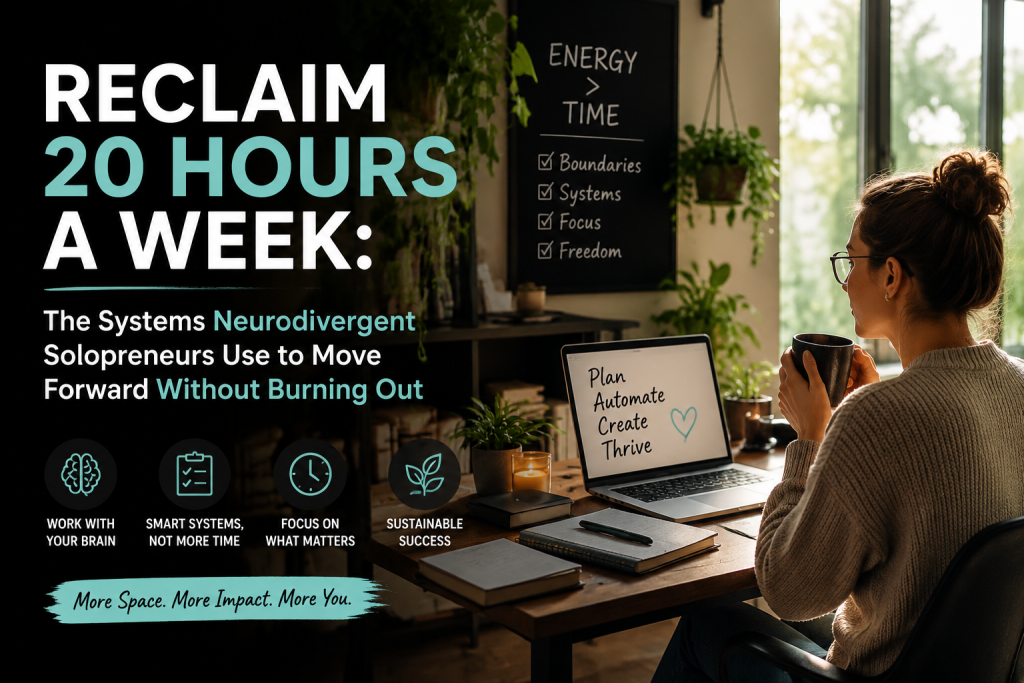
- Fragmented tools are a cognitive load problem, not a discipline problem — and they silently drain 15–25 hours per week.
- Structured operational systems designed around neurodivergent workflows recover time, reduce overwhelm, and create predictable progress.
- An all-in-one operational platform eliminates multi-tool chaos and replaces digital fragmentation with one stable environment.
- Scaling safely means starting with 10 hours of support per week and expanding as capacity allows.
- The goal is not productivity for productivity’s sake — it is sustainable operational capacity.
The Silent Capacity Drain Most Founders Miss
There is a hidden productivity thief operating inside most solopreneur businesses.
Multi-Tool Mayhem.
Although jumping between disconnected platforms may feel normal, every platform switch carries a measurable cost.
As a result, research and client observations consistently show that context switching and tool overload silently consume 15 to 25 hours weekly. Not because the workload increased. Because mental energy is spent managing systems instead of moving work forward.
“This is not a productivity problem. It is a system design problem.”
For neurodivergent founders — particularly those navigating ADHD, executive dysfunction, autism, or chronic illness — this fragmentation compounds quickly. Each transition between tools demands a cognitive reset. Over the course of a day, those resets accumulate into exhaustion.
If Your Day Feels Full but Progress Feels Slow, This Will Sound Familiar
The pattern is consistent:
- The day begins with clear intention
- A message interrupts
- An unexpected task appears
- An email demands attention
- Platform switching begins
- Momentum disappears
- Energy drops by afternoon
- Important work gets postponed
The day feels busy. Progress feels absent.
The issue is not effort. Instead, the real challenge is operational friction. Because friction is a system problem, it requires a system solution. Understanding what to look for in an inclusive virtual assistant organization is the first step toward replacing that friction with structure.
The Real Constraint Is Cognitive Load, Not Time
Neurodivergent founders consistently perform best when work becomes:
- Predictable — routines reduce decision fatigue
- Structured — clear sequences eliminate guesswork
- Visible — centralized systems reduce anxiety
- Consistent — repeatable workflows build momentum
When those conditions exist, output increases naturally. Consequently, founders experience stronger momentum without relying on pressure. Through alignment.
That is why neuro-inclusive operations support creates immediate relief. And it is why INVA now recommends consolidating scattered systems into one integrated operational environment.
Why INVA Recommends an All-In-One System
After observing recurring workflow bottlenecks across entrepreneurs and founders, INVA officially recommends an all-in-one operational platform designed to reduce cognitive load and create operational stability.
Instead of managing disconnected software, one system brings together:
| Function | Fragmented Approach | Integrated Approach |
|---|---|---|
| CRM | Separate platform | Unified dashboard |
| Sales Pipeline | Spreadsheet or standalone tool | Built-in pipeline view |
| Marketing Automations | Third-party tool | Native automation |
| Communication | Multiple inboxes | Centralized inbox |
| Task Tracking | Separate app | Integrated task board |
| Follow-Up Systems | Manual reminders | Automated sequences |
As a result, there is no digital duct tape, no constant tab switching, and no confusion about where information lives.
One predictable workflow. Designed to support execution.
Think of it as an operations partner that instantly organizes the digital workspace. The result: less mental clutter, more capacity, reduced overwhelm, and greater consistency.
Seven Systems for Neurodivergent Solopreneurs That Reduce Overwhelm
These are not productivity tricks. These are the systems for neurodivergent solopreneurs that reduce burnout, protect mental energy, and create predictable progress.
1. Inbox Stabilization System
Purpose: Reduce decision fatigue caused by unstructured email.
Outcome: Routine communication no longer steals attention from priority work.
2. Task Visibility System
Purpose: Centralize all priorities in one location.
Outcome: Reduced anxiety and stronger follow-through on commitments.
3. Lead Research Support System
Purpose: Protect focus during revenue-generating work.
Outcome: Consistent pipeline activity without cognitive interruption.
4. Proposal Preparation System
Purpose: Eliminate repetitive manual work.
Outcome: Faster delivery with significantly less mental effort.
5. Content Scheduling System
Purpose: Remove daily content decisions from the founder’s plate.
Outcome: Consistent visibility without constant creative output.
6. Calendar Protection System
Purpose: Preserve deep focus time blocks.
Outcome: More predictable, sustainable workdays.
7. Integrated Workflow System
Purpose: Eliminate platform overload and reduce context switching.
Process:
- Bring all workflows into one environment
- Automate repeatable processes
- Connect sales, communication, and operations
- Reduce digital fragmentation
Outcome: Less cognitive friction. More operational stability.
Explore INVA’s structured operational support services to see how these systems are implemented in practice.
Real Example: A Founder Recovered 22 Hours Per Week
A solopreneur running a service-based business struggled with constant interruptions, task switching, platform overload, and mental fatigue.
Before structured systems:
- Long, unproductive working hours
- Scattered workflows across multiple tools
- Digital chaos replacing operational clarity
After implementing structured systems and consolidating operations:
- 22 hours recovered weekly
- Predictable, repeatable workflow
- Reduced stress and decision fatigue
- Improved focus on revenue-generating work
Ultimately, the shift did not come from working harder. Instead, it came from removing friction.
The Safe Scale Path for Neurodivergent Solopreneurs
Growth should feel manageable — not overwhelming. INVA structures operational support in deliberate phases:
| Phase | Support Level | Focus |
|---|---|---|
| Phase 1 | 10 hours/week | Stabilize core workflows |
| Phase 2 | Expanded coverage | Automate and delegate |
| Phase 3 | Specialized roles + integrated systems | Scale with confidence |
Scaling slowly protects both cash flow and mental energy. Review transparent support pricing to identify the right entry point.
What Happens Next
When founders work with INVA, support goes beyond delegation. The focus is on creating systems that fit how work actually happens — not how it theoretically should.
That includes implementation support for the recommended all-in-one platform through INVA’s trained operations partners.
Clients receive:
- Estimated recoverable hours based on current workflow
- Workflow recommendations tailored to capacity
- Implementation guidance for the integrated platform
- Structured operational support from day one
- Access to implementation perks and a 30-day trial opportunity
Because the goal is not productivity for productivity’s sake. The goal is capacity. For deeper context on how neuro-inclusive support transforms business operations, explore how inclusive virtual assistant services improve team performance.
Conclusion: Make One Commitment Today
The systems for neurodivergent solopreneurs share one common principle: structure replaces willpower.
Choose one recurring task to simplify this week. Or identify one platform to eliminate. Every removed friction point creates room for meaningful, focused work.
Effort was never the real problem. Instead, sustainable systems create the stability neurodivergent solopreneurs need.
Here is the next step: stabilize operations by consolidating tools, implementing predictable workflows, and delegating execution to a structured support system built around how the brain actually works.
Ready to stop duct-taping the business together?
Build operational stability with INVA — and start recovering time that belongs to the work that matters most.
Frequently Asked Questions
Why do neurodivergent solopreneurs often struggle with overwhelm?
Neurodivergent solopreneurs frequently manage multiple roles, responsibilities, and disconnected systems at once. Constant context switching between emails, calendars, CRM platforms, project management tools, and client work increases cognitive load, making it harder to maintain focus, prioritize tasks, and sustain momentum throughout the day.
How can I reclaim more hours in my workweek?
Recovering time starts with reducing operational friction rather than working longer hours. Consolidating business systems, automating repetitive tasks, documenting workflows, delegating administrative work, and protecting focused work time can help founders recover several productive hours each week.
What systems help neurodivergent solopreneurs stay organized?
Effective systems include centralized task management, structured calendars, CRM workflows, documented standard operating procedures (SOPs), automated follow-ups, content scheduling, and predictable weekly planning routines. These systems reduce decision fatigue while improving consistency and execution.
What tools help reduce business overwhelm?
Many entrepreneurs rely on tools such as Notion, Asana, Trello, ClickUp, Calendly, Slack, Google Workspace, and HubSpot to organize different parts of their business. However, managing multiple platforms can increase complexity. For many founders, INVA recommends GoHighLevel because it combines CRM, communication, calendars, automation, workflows, websites, funnels, and marketing tools into one centralized platform, reducing context switching and improving operational efficiency.
Is reducing business overwhelm only about using better software?
No. Software is only one part of the solution. Sustainable productivity also depends on clear workflows, structured delegation, consistent routines, and operational systems that match how you naturally work. The combination of the right systems and the right support creates lasting improvements.
Can small operational changes really improve productivity?
Yes. Small improvements such as centralizing tasks, reducing unnecessary meetings, automating repetitive work, and creating documented workflows often produce significant gains over time. These changes reduce mental clutter and make it easier to focus on high-value work.
How can INVA help neurodivergent solopreneurs?
INVA AI-Augmented Operations Partners help founders build structured workflows, implement GoHighLevel, organize business systems, manage administrative operations, document processes, automate repetitive tasks, and provide ongoing operational support that reduces overwhelm while creating sustainable business growth.
Who benefits most from structured operational support?
Structured operational support is valuable for neurodivergent founders, ADHD entrepreneurs, autistic professionals, coaches, consultants, freelancers, virtual service providers, and growing small businesses that want to improve productivity without increasing burnout.
Can I start improving my systems before hiring support?
Yes. Begin by identifying your biggest sources of friction, eliminating duplicate tools, documenting one recurring workflow, and centralizing your daily tasks. These simple improvements create a stronger operational foundation and make future delegation much easier.
What is the first step toward building a more sustainable business?
Start by auditing how your business currently operates. Identify where time is being lost through repeated tasks, scattered information, and unnecessary platform switching. Once those bottlenecks are clear, you can simplify your systems, automate repetitive work, and build an operational structure that supports long-term growth instead of daily firefighting.