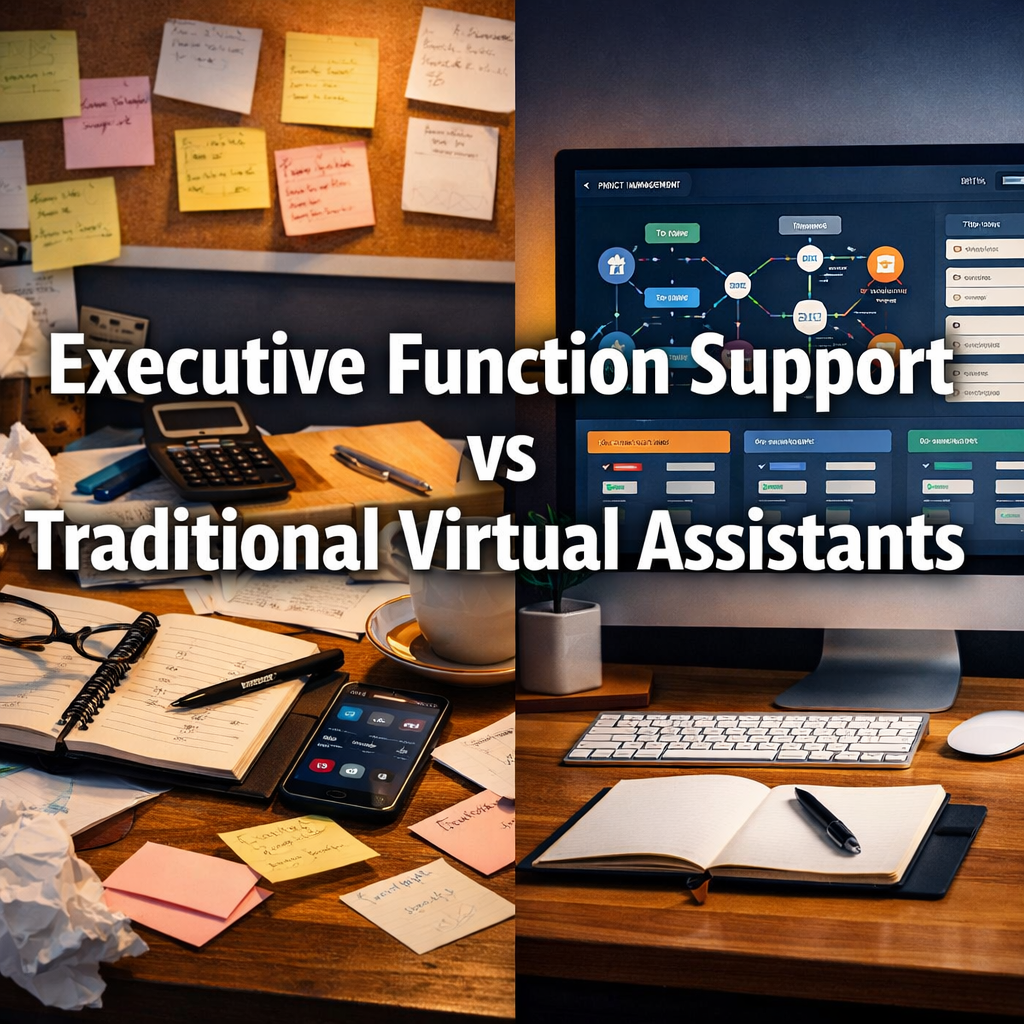
Eighty percent of the friction inside a service-based business is not a task problem. It is an executive function problem. Founders do not collapse under the weight of emails. Instead, they collapse under the weight of unmade decisions, scattered information, and workflows that depend entirely on memory and willpower. This is precisely where executive function support diverges from traditional virtual assistance, and why the distinction matters for entrepreneurs, coaches, and consultants managing complex operations across multiple time zones.
A traditional virtual assistant completes tasks. By contrast, an executive function support partner builds the system that makes those tasks unnecessary to think about in the first place.
Key Takeaways
- Traditional virtual assistants are task-based; executive function support is systems-based and impact-driven.
- Executive function support reduces cognitive load by structuring decisions, priorities, and follow-through, not just clearing inboxes.
- INVA practitioners operate as AI-Augmented Operations Partners, blending human judgment with AI workflow design.
- Neurodivergent founders benefit most from structured operational systems that prevent overwhelm rather than react to it.
- The right choice depends on whether you need task execution or operational infrastructure.
What Executive Function Support Actually Means
Executive functions govern planning, prioritization, working memory, attention regulation, and follow-through. When these systems are taxed, even capable founders lose hours to decision fatigue and context switching.
In other words, executive function support replaces internal cognitive effort with external operational structure. Instead of remembering, the system remembers. Instead of deciding repeatedly, the workflow decides once. This is the foundation of neuro-inclusive operations support for entrepreneurs.
What Traditional Virtual Assistants Deliver
Traditional VAs are remote professionals who execute discrete administrative tasks: email triage, calendar coordination, research, data entry, social posting, and customer service. They work within existing systems and respond to instructions.
However, this model works only when the founder already has clear workflows, defined priorities, and the cognitive bandwidth to direct the work. As a result, when those conditions are absent, adding a VA often creates another layer to manage rather than providing relief.
The Core Difference: Tasks vs Systems
| Dimension | Traditional Virtual Assistant | Executive Function Support (INVA) |
|---|---|---|
| Orientation | Task completion | Systems and outcomes |
| Approach | Reactive to instructions | Proactive workflow design |
| Cognitive Load on Founder | Founder directs the work | Founder is supported in deciding |
| AI Integration | Minimal or absent | Core to delivery |
| Training | Administrative skills | Neuro-affirming practice plus AI operations |
| Output | Completed tasks | Predictable operational infrastructure |
The distinction is captured well in industry analysis: general VAs are task-based, while executive-level support is impact-driven and tied to priorities and decision support.
How Executive Function Support Works in Practice
An INVA practitioner functions as an AI-Augmented Operations Partner. Delivery is structured around four operational pillars:
Prioritization and Planning. Competing demands are organized into sequenced actions. Large projects are decomposed into executable units. The founder stops re-deciding what to work on each morning.
Knowledge and Information Management. Notes, decisions, documents, and client context live in structured systems. Nothing depends on memory.
AI-Powered Workflow Design.Repetitive work is automated. Additionally, meetings are summarized. Furthermore, communication is templated.The AI-augmented operations framework becomes the execution layer between founder and chaos.
Accountability and Momentum.Structured check-ins replace willpower with rhythm. Consequently, progress becomes predictable rather than heroic.
Traditional VAs work inside your systems. Executive function support builds the system itself.
Which Model Fits Your Operation
For example, if workflows are already documented and the bottleneck is volume, a traditional VA is sufficient. However, if the bottleneck is overwhelm, executive dysfunction, inconsistent follow-through, or fragmented information, executive function support is the correct intervention.
This is particularly relevant for neurodivergent founders and teams operating under fluctuating capacity, chronic illness, or ADHD. Reviewing operational support pricing clarifies which engagement model aligns with current operational reality.
Conclusion
The choice is not between cheaper or more expensive support. It is between buying task hours and buying operational infrastructure. Traditional virtual assistants reduce workload. Executive function support reduces cognitive load and rebuilds the system that produced the workload in the first place.
Next steps:
- Audit whether the current bottleneck is task volume or decision volume.
- Document one recurring workflow that consumes disproportionate mental energy.
- Hire an INVA practitioner to convert that workflow into structured, AI-augmented operations.
The objective is not doing more. It is building systems that make consistent execution inevitable.
Frequently Asked Questions
1. What is the difference between Executive Function Support and a traditional virtual assistant?
A traditional virtual assistant primarily completes assigned tasks such as managing emails, scheduling meetings, and performing administrative work. Executive Function Support goes a step further by creating the systems behind those tasks. It focuses on planning, prioritization, workflow design, accountability, and operational structure, helping founders reduce cognitive load instead of simply delegating work.
2. Which founders should hire Executive Function Support instead of a traditional virtual assistant?
Executive Function Support is best suited for entrepreneurs, consultants, coaches, agency owners, and executives who struggle with decision fatigue, inconsistent execution, operational overwhelm, or managing multiple priorities. If your biggest challenge is staying organized and moving work forward consistently, Executive Function Support is likely a better fit than traditional task-based assistance.
3. When is a traditional virtual assistant the right choice?
A traditional virtual assistant is ideal when your workflows are already documented, your priorities are clear, and you simply need help executing recurring administrative tasks. If your business already has strong operational systems, a VA can efficiently reduce workload by handling routine activities.
4. Can I work with both an Executive Function Support Partner and a traditional virtual assistant?
Yes. Many growing businesses combine both. An Executive Function Support Partner designs and manages the operational systems, while a traditional virtual assistant works within those systems to complete recurring tasks. This combination allows founders to improve both execution and efficiency without becoming the operational bottleneck.
5. What tools do Executive Function Support Partners use compared to traditional virtual assistants?
Executive Function Support Partners typically work with both productivity platforms and AI-powered tools, including ChatGPT, Claude, Gemini, Perplexity, Notion, ClickUp, Asana, Trello, Slack, Google Workspace, Microsoft 365, Zapier, Make, Airtable, Calendly, HubSpot, and CRM systems. Rather than replacing your existing software, they optimize how those tools work together to support consistent execution.
6. What outcomes can I expect from Executive Function Support that a traditional virtual assistant may not provide?
While a traditional virtual assistant helps reduce workload, Executive Function Support helps reduce cognitive load. Businesses often experience clearer priorities, stronger accountability, improved workflows, better knowledge management, fewer operational bottlenecks, more effective AI integration, and greater consistency across daily operations.
7. Is Executive Function Support only useful for neurodivergent founders?
No. Executive Function Support benefits any founder managing complex operations or rapid business growth. However, it is particularly valuable for entrepreneurs with ADHD, autism, executive functioning challenges, chronic illness, or fluctuating capacity because it creates external systems that reduce reliance on memory, constant decision-making, and willpower.
8. How does INVA deliver Executive Function Support differently from traditional virtual assistant services?
INVA Practitioners combine Executive Function Support with AI-Augmented Operations and neuro-inclusive operational practices. Every practitioner is trained through the Mastering Inclusive Support framework, enabling them to build operational systems, implement AI-assisted workflows, strengthen accountability, and design processes that support sustainable business growth rather than simply completing administrative tasks.
9. How do I know if my business has outgrown a traditional virtual assistant?
Your business may be ready for Executive Function Support if you regularly repeat instructions, rely heavily on memory, struggle to prioritize competing projects, use disconnected tools, experience frequent operational bottlenecks, or spend more time coordinating work than leading your business. These are often indicators that stronger systems, not simply more task support, are needed.
10. How do I get started with Executive Function Support through INVA?
The process begins with understanding your current workflows, operational challenges, and business goals. INVA then matches you with an Executive Function Support Partner whose expertise aligns with your needs. Together, you build AI-supported systems, accountability structures, and operational workflows that reduce friction, improve execution, and create a more scalable business.
References
[1] Watch – https://www.youtube.com/watch?v=e2AI2zgTVkY
[2] Mercy Bassey Austine on Virtual Assistants – https://www.linkedin.com/posts/mercy-bassey-austine_difference-between-a-virtual-assistant-and-activity-7393994659309555713-Go7a
[3] Facebook – General VA vs Executive Assistant – https://www.facebook.com/miajuan726/posts/a-lot-of-people-think-general-virtual-assistants-and-executive-assistants-are-th/1479547804183138/
[4] Executive Vs Virtual Assistant – https://proassisting.com/resources/articles/executive-vs-virtual-assistant/
[5] What Is A Virtual Assistant And Why Is It Important – https://execviva.com/what-is-a-virtual-assistant-and-why-is-it-important/
[6] Executive Assistant Vs Virtual Assistant – https://portiva.com/executive-assistant-vs-virtual-assistant/
[7] Virtual Assistant Vs Executive Assistant – https://donnapro.com/comparison/virtual-assistant-vs-executive-assistant/
[8] Iniobong Ekpe on Executive Virtual Assistants – https://www.linkedin.com/posts/iniobong-ekpe-b11871146_who-is-an-executive-virtual-assistant-let-activity-7350527653596008448-5Y_D