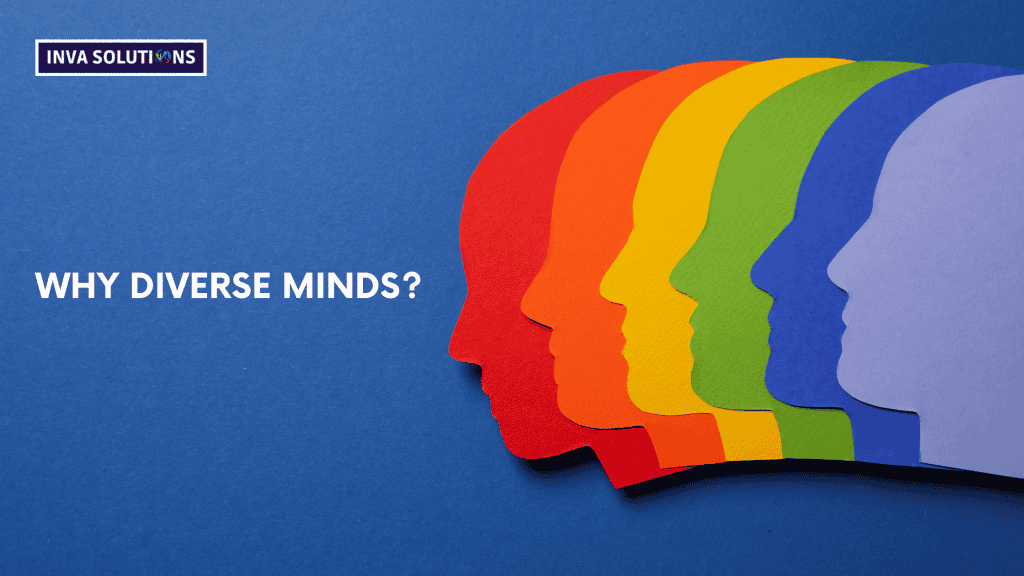
Why Diverse Minds?
Diverse minds are not a trend. They are a competitive advantage.
Organizations that embrace cognitive diversity, different ways of thinking, processing, communicating, and problem-solving consistently outperform those built on sameness. When teams include neurodivergent professionals alongside neurotypical colleagues, innovation deepens, blind spots shrink, and performance strengthens.
The real question isn’t whether diverse minds matter. It’s whether your systems are designed to support them.
Innovation Comes From Difference
Breakthrough ideas rarely come from identical perspectives. They emerge when people approach challenges from multiple angles.
Neurodivergent professionals often bring strengths such as:
Deep analytical thinking
Creative pattern recognition
Hyperfocus on complex problems
High attention to detail
System-level thinking
When these strengths are supported instead of suppressed, teams solve problems faster and more effectively.
If your organization wants to harness these strengths intentionally, explore our neurodiversity training for companies
Performance Improves With Cognitive Diversity
Research consistently shows that diverse teams make better decisions. Why? Because varied thinking styles reduce groupthink.
When everyone processes information the same way, risks go unnoticed and assumptions go unchallenged. Diverse minds introduce constructive friction, the kind that sharpens ideas instead of derailing them.
But diversity alone is not enough. Inclusion is what activates performance.
Without inclusive structures, diverse talent either burns out or leaves.
Inclusive Systems Unlock Potential
Supporting diverse minds requires more than hiring initiatives. It requires operational shifts:
Clear communication instead of vague expectations
Flexible workflows instead of rigid norms
Strength-based role design instead of personality-based assumptions
Psychological safety instead of silent masking
When organizations redesign systems to support neurodiversity, productivity increases across the board not just for neurodivergent employees.
Learn how to operationalize inclusive practices through our inclusive workplace strategy programs
Diverse Minds Strengthen Culture
Inclusion builds trust. Trust builds retention. Retention builds institutional strength.
When employees feel safe to think differently, ask questions, and contribute authentically, collaboration improves. Teams become more resilient, adaptive, and forward-thinking.
Diverse minds don’t weaken culture. They evolve it.
The Business Case Is Clear
Companies that prioritize cognitive diversity see measurable benefits:
Stronger innovation pipelines
Better decision-making
Higher employee engagement
Improved employer brand credibility
Expanded access to global talent
In a competitive international marketplace, sameness is a liability. Diverse minds are leveraged.
If your organization is ready to build systems that support neurodiversity at scale, discover how we help companies implement structured, sustainable inclusion frameworks.
Because when diverse minds are supported, performance follows.
Frequently Asked Questions
What are diverse minds in the workplace?
Diverse minds refer to people with different ways of thinking, learning, communicating, solving problems, and processing information. This includes both neurodivergent and neurotypical individuals whose varied perspectives contribute to stronger innovation, better decision-making, and more resilient organizations.
Why is cognitive diversity important for businesses?
Cognitive diversity enables teams to approach challenges from multiple perspectives, reducing groupthink while improving creativity, problem-solving, and innovation. Organizations that value different thinking styles are often better equipped to adapt to change and make more informed business decisions.
How do inclusive teams improve business performance?
Inclusive teams create environments where employees feel safe to contribute ideas, challenge assumptions, and collaborate effectively. This often leads to higher employee engagement, stronger retention, improved innovation, better customer outcomes, and more sustainable business growth.
What tools help organizations build more inclusive teams?
Many organizations use platforms such as Microsoft Teams, Slack, Google Workspace, Notion, Asana, ClickUp, Trello, Monday.com, and Zoom to improve communication and collaboration. For organizations seeking a more centralized operational approach, INVA often recommends GoHighLevel, which combines communication, CRM, workflows, automation, calendars, and client management into one platform, helping teams reduce complexity while improving operational alignment.
What is the difference between diversity and inclusion?
Diversity refers to the variety of people, backgrounds, experiences, and thinking styles within an organization. Inclusion is the practice of creating an environment where those differences are respected, supported, and empowered to contribute meaningfully. Diversity brings people into the organization, while inclusion helps them succeed.
How can organizations create more inclusive teams?
Organizations can strengthen inclusion by improving communication, building psychologically safe workplaces, reviewing hiring and management practices, designing flexible operational systems, providing neurodiversity education, and creating opportunities for every employee to contribute according to their strengths.
How does INVA help organizations build inclusive teams?
INVA helps organizations transform cognitive diversity into a strategic advantage through neuro-inclusive workplace consulting, leadership development, AI-augmented operational support, inclusive systems design, and practical implementation strategies. Our focus is helping organizations build high-performing teams where diverse minds can thrive together.
Which organizations benefit most from cognitive diversity?
Organizations across every sector can benefit from cognitive diversity, including startups, SMEs, corporations, nonprofits, educational institutions, healthcare providers, government agencies, and remote-first businesses. Any organization seeking greater innovation, stronger collaboration, and sustainable growth can benefit from building more inclusive teams.
Can investing in inclusion improve business results?
Yes. Research consistently shows that organizations with inclusive cultures often experience stronger innovation, higher employee engagement, improved retention, better decision-making, enhanced employer reputation, and greater long-term business resilience.
What is the first step toward building a more inclusive team?
Start by evaluating how your organization currently supports different ways of thinking. Review leadership practices, communication methods, recruitment processes, workflow design, and team culture to identify barriers that limit participation. From there, implement practical changes that enable every employee to contribute their strengths and perform at their full potential.