In the bustling boardrooms of Nairobi, Dar es Salaam, and Kampala, a new priority is climbing the executive agenda. It’s not just about AI integration or hybrid work models; it’s about the minds that power them.
For HR Directors, L&D Managers, and Operations Leaders across East Africa, the challenge is clear: staff turnover in key sectors like banking and energy is reaching critical levels (averaging 14.6% in Kenya alone). But what if the “talent flight” you’re experiencing isn’t just a market trend, but a symptom of cognitive exclusion?
Enter the Neuroinclusive Performance AcceleratorTM, the first data-driven framework designed specifically for the East African corporate landscape.
The "Silent Drain": What Your Balance Sheet Isn't Telling You
Traditional leadership models in the region are often built on a “one-size-fits-all” approach. However, global research and our own regional data reveal a staggering reality: disengaged employees cost an organization 34% of their annual salary in lost productivity.
In the Kenyan context, a single disengaged middle manager earning KES 300,000 per month represents an invisible leak of over KES 1.2 million per year. When you multiply that across a department, the financial impact is devastating.
Why Traditional DEIB is Failing
Most DEIB (Diversity, Equity, Inclusion, and Belonging) strategies in East Africa focus heavily on gender and ethnic representation. While vital, these frameworks often stop at the “compliance floor” of the Kenya Persons with Disabilities Act (2003).
True performance leadership requires moving to the “performance ceiling” by embracing Neurodiversity, the 20% of your workforce that processes information differently due to ADHD, Autism, Dyslexia, and other cognitive profiles.
Global Benchmarks, African Heart: The AcceleratorTM Advantage
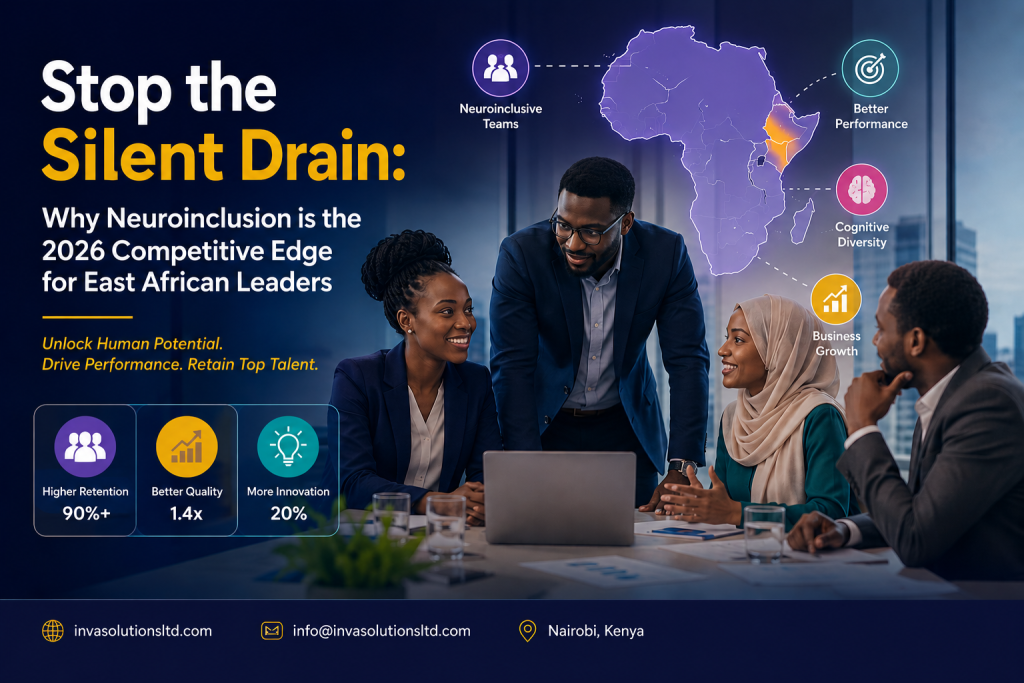
International pioneers like Microsoft, SAP, and EY have already proven the business case. Microsoft reports a 90%+ retention rate for neurodivergent talent, while EY teams, including neurodivergent members, show a 1.4x increase in work quality.
The Neuroinclusive Performance AcceleratorTM brings these global standards to the East African context through a structured 6-module journey:
1. Understanding Cognitive Diversity: Moving beyond labels to unlock human potential.
2. Leading Neurodiverse Teams: Shifting from command-and-control to inclusive coaching.
3. Inclusive Communication: Bridging the processing gap in high-context regional cultures.
4. Psychological Safety: Building the foundation for innovation and disclosure.
5. Performance and Productivity: Measuring contribution, not just compliance.
6. Sustainable Inclusion: Embedding neurodiversity into your ESG and Policy DNA.
Real-World Impact: The 20% Innovation Surge
Neuroinclusive teams are 20% more likely to generate novel solutions to complex business challenges. Whether it’s a Fintech firm in Nairobi hyper-focusing on a product launch or a manufacturing plant in Thika reducing safety incidents by 15%, the ROI is measurable and immediate.
“Neuroinclusion isn’t a ‘nice-to-have’—it’s the strategic lever that separates high- performing organizations from those stuck in the cycle of attrition.” — INVA Solutions
Ready to Unlock Your Team's Full Potential?
Stop guessing why your top talent is leaving. Identify the productivity leaks in your organization and start building a culture where every mind can thrive.
Take the first step toward a high-performance, neuro-inclusive future.
Frequently Asked Questions
What is neuroinclusive leadership?
Neuroinclusive leadership is the practice of designing workplace systems, communication, and management approaches that support employees with different thinking and processing styles. It focuses on creating environments where diverse cognitive strengths contribute to better business performance and innovation.
Why should East African organizations prioritize neuroinclusion?
Organizations across East Africa face increasing competition for skilled talent. Neuroinclusive leadership helps improve employee engagement, strengthen retention, encourage innovation, and create workplaces where people can perform at their best regardless of how they think or process information.
How is neuroinclusion different from traditional DEIB initiatives?
Traditional DEIB initiatives often focus on representation and compliance. Neuroinclusion goes further by examining how workplace systems, communication, leadership practices, and operational processes affect employees with different cognitive profiles and ensuring those systems support high performance for everyone.
What are the business benefits of building a neuroinclusive workplace?
Neuroinclusive workplaces often experience higher employee engagement, improved collaboration, stronger innovation, better problem-solving, increased retention, and reduced costs associated with turnover and disengagement. Inclusive systems also help organizations attract a broader range of skilled professionals.
What are the first signs that an organization needs a more neuroinclusive approach?
Common signs include high employee turnover, communication breakdowns, burnout, inconsistent performance, difficulty retaining skilled staff, and employees feeling overwhelmed by unclear processes or expectations. These challenges often point to systems that need redesign rather than people who need fixing.
Can neuroinclusive leadership improve organizational performance?
Yes. When employees work within systems that support different thinking styles, they can contribute more effectively. Clear communication, structured workflows, psychological safety, and inclusive leadership practices help teams perform more consistently while encouraging creativity and innovation.
How can organizations begin implementing neuroinclusive leadership?
A practical starting point is reviewing existing workplace systems, communication practices, management approaches, and employee experiences. From there, organizations can identify barriers, provide leadership training, and introduce structured operational improvements that make inclusion part of everyday business.
What industries benefit most from neuroinclusive leadership?
Neuroinclusive leadership benefits organizations across sectors, including finance, healthcare, education, technology, manufacturing, professional services, government, and nonprofit organizations. Any workplace that depends on innovation, collaboration, and skilled talent can benefit from more inclusive systems.
How does INVA support organizations building neuroinclusive workplaces?
INVA helps organizations strengthen neuroinclusive leadership through workplace assessments, leadership development, AI-augmented operational strategies, neurodiversity training, and practical implementation frameworks that help businesses move from awareness to measurable action.
What is the first step toward creating a neuroinclusive organization?
The first step is recognizing that workplace performance is influenced by the systems employees work within. By evaluating leadership practices, communication processes, and operational structures, organizations can begin building environments where every employee has the opportunity to contribute and succeed.