Forty-seven open browser tabs. Three unfinished emails. A calendar invite ignored for six days. A brilliant idea scribbled on a napkin somewhere. This is not laziness. This is executive dysfunction, and it is costing founders revenue, relationships, and rest.
Understanding how an ADHD virtual assistant reduces executive dysfunction is no longer optional for neurodivergent entrepreneurs. It is operational infrastructure. The right support layer transforms scattered energy into structured execution, replacing willpower with systems that hold.
Key Takeaways
- Executive dysfunction disrupts task initiation, prioritization, and follow-through — not intelligence or drive.
- An ADHD virtual assistant builds external systems that reduce cognitive load and stabilize daily operations.
- AI-augmented operations partners outperform task-based assistants by designing the workflows behind the work.
- Accountability, structure, and automation are the three execution layers founders need most.
- Neuro-affirming support changes the systems around you, not who you are.
What Executive Dysfunction Actually Costs Founders
Executive functions govern planning, working memory, task initiation, and follow-through. When disrupted, capable founders experience missed deadlines, decision fatigue, constant context switching, and inconsistent output.
The cost is rarely measured in hours. It is measured in stalled launches, dropped clients, and quiet burnout.
| Symptom | Operational Impact | System Solution |
|---|---|---|
| Task paralysis | Stalled projects | Structured task initiation workflows |
| Forgotten follow-ups | Lost revenue | Documented CRM and reminder systems |
| Decision fatigue | Avoidance and delay | Prioritization frameworks |
| Mental overload | Burnout cycles | Cognitive load offloading |
| Time blindness | Missed deadlines | Time-aware scheduling systems |
How an ADHD Virtual Assistant Reduces Executive Dysfunction Through Structure
An ADHD-aware operations partner does not wait for instructions. They build the architecture that holds your business steady.
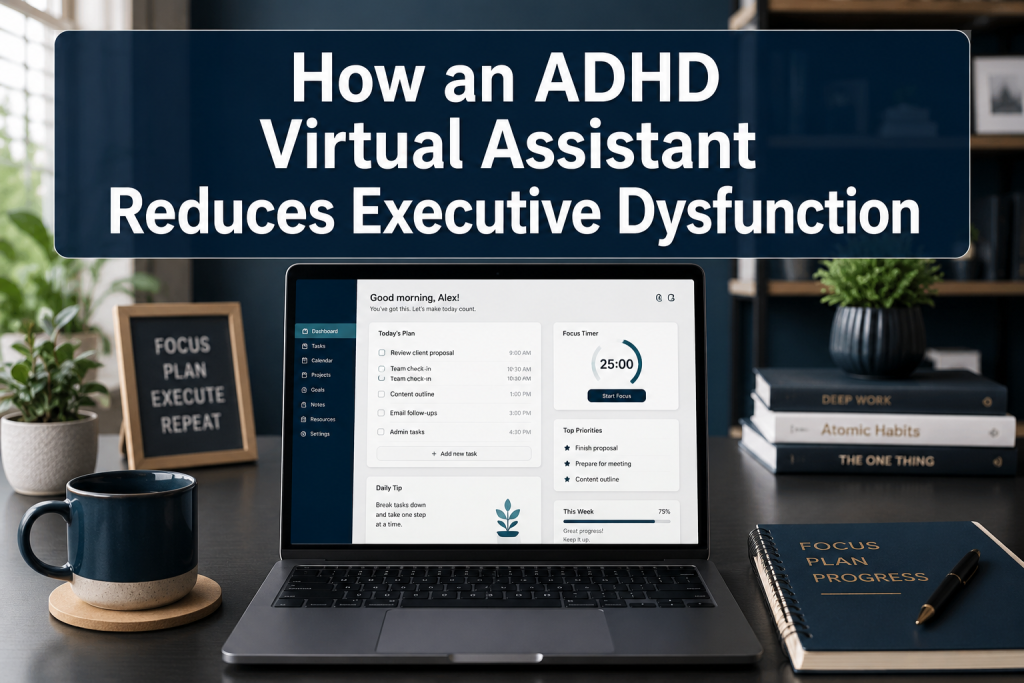
1. Structure replaces memory. Daily priorities are captured in dashboards, not in your head. Tasks are sequenced. Reminders are automated. Context is documented.
2. Accountability replaces motivation. Regular check-ins, milestone reviews, and progress tracking maintain momentum when energy fluctuates. This is the foundation of the INVA Accountability Partner Program.
3. Automation replaces repetition. AI-augmented workflows handle meeting notes, research synthesis, document organization, and content preparation — work that drains executive function but rarely requires it.
“We do not react to chaos. We build systems that prevent it.”
How an ADHD Virtual Assistant Reduces Executive Dysfunction Differently Than Traditional VAs
Most virtual assistants complete tasks. An ADHD-informed operations partner designs the systems behind the tasks.
Traditional VAs are reactive. They wait for direction. For a founder with executive dysfunction, this is another decision to make, another instruction to write, another open loop to manage.
INVA practitioners operate differently:
- They identify bottlenecks before they escalate.
- They document repeatable processes so knowledge does not live in one person’s head.
- They integrate AI tools to compress hours of administrative work into minutes.
- They communicate in clear, structured updates — not scattered messages.
This is the difference between hiring help and building execution infrastructure.
How an ADHD Virtual Assistant Reduces Executive Dysfunction at INVA
Every INVA practitioner supporting neurodivergent clients completes the Mastering Inclusive Support certification and demonstrates competency in our AI-Augmented Operations Framework.
The result: a structured support layer that combines human judgment, neuro-affirming practice, and AI capability. Founders gain operational clarity without sacrificing autonomy.
The right support does not change who you are. It changes the systems around you, so you can do your best work with greater clarity, confidence, and consistency.
Conclusion: Build the System Before the Breakdown
Executive dysfunction is not a character flaw. It is a signal that the operating system around you needs reinforcement. An ADHD virtual assistant — specifically an AI-augmented operations partner — delivers that reinforcement through structure, accountability, and automation.
Next steps:
- Identify your three most draining operational bottlenecks this week.
- Document one repeatable workflow you currently hold only in memory.
- Hire an INVA practitioner trained in neuro-inclusive operations support.
Looking for an ADHD virtual assistant who understands executive dysfunction? Discover how an INVA Practitioner can help you build systems that reduce cognitive overload, improve follow-through, and give you more time to focus on growing your business.
| Support Type | Best For | Systems Thinking | AI Integration | Accountability |
|---|---|---|---|---|
| Traditional VA | Single tasks | Low | Low | Low |
| VA Agency | Admin volume | Medium | Low | Medium |
| AI Tools Only | Self-managers | Low | High | None |
| Ops Consultant | Strategy only | High | Medium | Low |
| INVA Practitioner | Neurodivergent founders | High | High | High |
Frequently Asked Questions
1. What is executive dysfunction, and why does it affect founders?
Executive dysfunction refers to difficulties with planning, organizing, prioritizing, initiating tasks, managing time, and following through on responsibilities. For founders, these challenges can slow business growth even when they have strong ideas, expertise, and motivation.
2. Can an ADHD virtual assistant help with time management?
Yes. An ADHD virtual assistant helps build systems for scheduling, reminders, task prioritization, calendar management, and follow-up tracking. These external systems reduce the mental effort required to stay organized and meet deadlines consistently.
3. How is an ADHD virtual assistant different from productivity coaching?
Productivity coaching often focuses on developing habits and strategies. An ADHD virtual assistant provides hands-on operational support by helping implement those strategies, manage daily workflows, and maintain accountability through structured systems.
4. What business tasks should founders delegate first?
Many founders begin by delegating email management, calendar coordination, CRM updates, meeting preparation, research, document organization, recurring administrative work, and workflow documentation. Delegating repetitive tasks creates more time for strategic decision-making.
5. Why do ADHD founders benefit from external accountability?
Accountability creates consistent momentum when motivation fluctuates. Regular check-ins, progress tracking, and structured follow-up reduce procrastination, improve task completion, and make it easier to maintain focus on high-priority work.
6. Can AI reduce executive dysfunction for entrepreneurs?
AI can automate repetitive administrative work such as note-taking, research, drafting documents, organizing information, and summarizing meetings. When combined with human operational support, AI helps reduce cognitive load while improving consistency and efficiency.
7. What makes an INVA Practitioner different from a traditional virtual assistant?
INVA Practitioners are trained as AI-Augmented Operations Partners who understand executive function challenges and neuro-inclusive work practices. Rather than simply completing assigned tasks, they build sustainable systems that improve productivity and support long-term business growth.
8. How do I know if I need an ADHD virtual assistant?
If important tasks are regularly delayed, deadlines are frequently missed, administrative work feels overwhelming, or your business depends too heavily on memory instead of systems, an ADHD virtual assistant may help create the operational structure needed to improve consistency.
9. Can an ADHD virtual assistant support teams as well as founders?
Yes. While many ADHD virtual assistants work directly with founders, they can also help teams improve communication, organize workflows, maintain documentation, coordinate projects, and establish systems that benefit the entire organization.
10. How can I get started with an INVA Practitioner?
Start by identifying the operational tasks that consume the most mental energy each week. INVA matches founders with practitioners trained in neuro-inclusive operations, accountability systems, and AI-augmented workflows that reduce executive dysfunction and support sustainable growth.
References
[1] getflowmind – https://getflowmind.io/?utm_source=openai
[2] Neuro – https://taalk.com/neuro/?utm_source=openai
[3] execuallc – https://execuallc.com/?utm_source=openai
[4] Personal CRM for Founders ADHD Minds Codot’s Voice AI – https://codot.ai/blog/codot-for-founders/personal-crm-for-founders-adhd-minds-codot-s-voice-ai?utm_source=openai
[5] meeteddie.app – https://meeteddie.app/?utm_source=openai
[6] About TalkToTali – https://talktotali.ai/about.html?utm_source=openai
[7] VADHD – https://www.franhennessycreative.co.uk/vadhd?utm_source=openai
[8] About Volkara – https://volkara.stormlightlabs.org/about?utm_source=openai
[9] About New Agenda Coaching – https://newagendacoaching.com/about/?utm_source=openai
[10] About GrowNOW ADHD – https://www.grownowadhd.com/about/?utm_source=openai