Key Takeaways
- Workflow fragmentation — not location — is the primary driver of cognitive overload in hybrid environments
- Neurodivergent founders thrive with predictable, centralized, and structured operational systems
- Scaling capacity does not require hiring more staff; it requires stabilizing existing workflows
- A five-step Hybrid Work Stability Framework reduces interruptions and protects deep focus
- Structured operational support delivers measurable results: recovered hours, reduced decision fatigue, and consistent execution
If Hybrid Work Feels Chaotic Instead of Flexible, This Will Sound Familiar
In fact, patterns like these are not random. They are symptoms of workflow fragmentation.
- A task starts but gets interrupted before completion
- Messages arrive faster than responses are possible
- Workdays feel busy but meaningful progress feels slow
- Important work gets postponed because urgent tasks keep appearing
This is not a discipline problem. It is not a focus problem either. Instead, the real issue is the way work systems are designed.
Consequently, fragmentation increases cognitive load. For founders navigating executive dysfunction, ADHD, autism, or chronic illness, that load compounds quickly. The brain spends energy managing chaos instead of executing strategy.
“Cognitive load reduction is not a luxury for neurodivergent founders. It is the foundation that makes everything else possible.”
The Real Constraint in Hybrid Work Is Not Location. It Is Decision Overload.
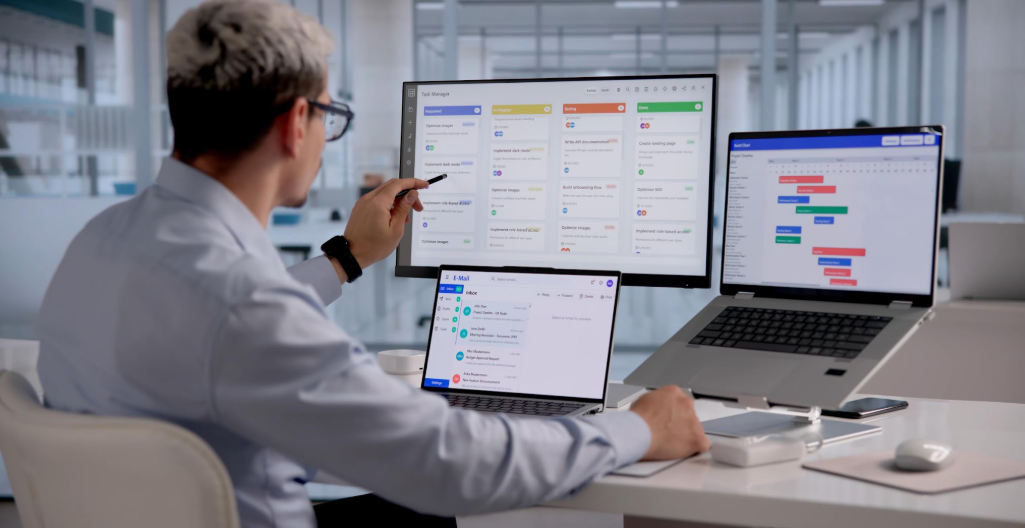
Neurodivergent founders perform best when work is predictable. They thrive when:
| Condition | Impact |
|---|---|
| Communication is centralized | Fewer context switches |
| Tasks are clearly assigned | Reduced mental clutter |
| Interruptions are filtered | Protected focus time |
| Schedules remain consistent | Lower daily stress |
When those conditions exist, hybrid work becomes manageable.
However, without them, it becomes exhausting.
Therefore, structured operational support for neurodivergent entrepreneurs restores stability. This is the foundation of Hybrid Work Systems for Neurodivergent Founders: Scale Without Hiring More Staff, building the conditions where focus is protected by design, not by willpower.
The Hybrid Work Stability Framework
Specifically, this framework reduces interruptions and protects focus. Not to add complexity. To remove friction.
1 — Communication Filtering System: Reduce constant message interruptions.
- Centralize communication channels into one primary platform
- Prioritize urgent messages with a clear escalation protocol
- Route routine questions through structured template
- As a result: Fewer interruptions. Clearer priorities.
2 — Calendar Protection System: Safeguard uninterrupted work blocks.
- Schedule meetings intentionally within defined windows
- Block deep work periods as non-negotiable
- Prevent overbooking through structured availability rules
- Ultimately: More predictable workdays.
3 — Task Visibility System: Prevent forgotten or duplicated work.
- Centralize all tasks in one project management system
- Assign responsibilities clearly with deadlines
- Track progress consistently without manual follow-up
Consequently: Reduced mental clutter.
4 — Daily Workflow Rhythm: Create consistency across the day.
- Morning: planning and priority confirmation
- Midday: focused execution blocks
- End of day: preparation and handoff documentation
In turn: Stable routines and reduced decision fatigue.
Step 5 — Weekly Adjustment Review: Prevent workflow drift.
- Review completed work against priorities
- Identify bottlenecks before they compound
- Adjust the following week’s structure proactively
As a result: Continuous improvement without overwhelm.
Real Example: A Hybrid Founder Recovered Control of Their Schedule
A founder managing a hybrid service business struggled with constant interruptions and scattered communication across four platforms.
Before structured support:
- Frequent task switching disrupted every work block
- Workdays were unpredictable and exhausting
- Long evenings were spent finishing tasks that should have been completed by noon
After implementing structured workflow systems:
As a result, the business experienced measurable improvements across operations.
- 15 hours recovered weekly
- Clear daily priorities established before 9am
- Reduced decision fatigue across the full week
- Improved team coordination without additional hires
The change did not come from hiring more staff. Instead, operational stability created the breakthrough. That principle sits at the heart of neuro-inclusive operations support: build structure first, then scale with confidence.
What Stable Hybrid Work Looks Like

| Before Support | After Support |
|---|---|
| Messages from multiple platforms | Centralized communication |
| Meetings scheduled unpredictably | Protected focus time |
| Tasks scattered across tools | Clear workflow ownership |
| Reactive daily decisions | Proactive structured planning |
This is operational stability. And operational stability is what makes growth sustainable.
The Safe Scaling Path for Neurodivergent Founders
Growth must remain manageable. The safest progression is structured expansion.
1 — Stabilize workflows Implement communication filtering, task visibility, and daily rhythm systems.
2 — Delegate routine coordination Move recurring operational tasks to role-based support so cognitive energy is reserved for high-value decisions.
3 — Expand support as workload grows Add capacity through structured general support services without disrupting the systems already in place.
Ultimately, scaling without structure increases stress. Conversely, scaling with structure increases capacity.
The Hybrid Work Capacity Check
Answer these questions honestly:
- Do interruptions break your focus frequently?
- Are you constantly switching between tools?
- Have messages started piling up faster than you can respond?
- Does mental exhaustion follow you through most workdays?
- Are important tasks being postponed because smaller ones feel urgent?
If three or more answers are yes, then your workflow needs stabilization rather than more effort.
What Happens During the 30-Minute Workflow Review

This session delivers clarity quickly. Here is the plan:
- Identify the biggest workflow bottlenecks currently draining attention
- Map the tasks and decisions creating the most daily friction
- Recommend the fastest stabilization step with immediate impact
Ultimately, the session takes just 30 minutes and delivers a clear, structured workflow path forward.
Explore transparent support pricing and understand exactly what structured operational support delivers before committing.
Make One Commitment Today
Choose one workflow boundary to protect starting tomorrow:
- Block one uninterrupted work period
- Delegate one recurring task
- Centralize one communication channel
Even better, that single action reduces cognitive load immediately. As a result, momentum begins with structure.
Conclusion: Structure Is the Strategy
Hybrid Work Systems for Neurodivergent Founders: Scale Without Hiring More Staff is not about working harder. It is about building the operational conditions where focused, sustainable work becomes the default — not the exception.
Ultimately, fragmented workflows are not a personal failure.
Rather, they are a systems gap. And systems gaps have structured solutions.
The next step is clear: book a 30-minute workflow review and identify the fastest path to operational stability. No vague advice. No generic frameworks. A specific plan for your specific operation.
Book your workflow review today and build the structure that lets you scale without adding to your overhead.
Frequently Asked Questions
What are hybrid work systems?
Hybrid work systems are structured operational processes that help teams collaborate effectively across remote and in-office environments. They combine clear communication, centralized workflows, defined responsibilities, and predictable routines to reduce confusion, improve productivity, and support sustainable business growth.
Why do neurodivergent founders often struggle in hybrid work environments?
Hybrid work can increase cognitive load when communication, tasks, and decisions are spread across multiple platforms. Constant interruptions, context switching, and unclear workflows make it more difficult to maintain focus, prioritize effectively, and protect deep work, especially for founders with ADHD, autism, executive dysfunction, or other cognitive differences.
How can I improve hybrid team productivity without hiring more staff?
Many businesses improve productivity by strengthening their existing operational systems before expanding their teams. Centralizing communication, documenting workflows, automating repetitive processes, improving delegation, and reducing unnecessary meetings often create more capacity without increasing payroll costs.
What tools help manage hybrid work more effectively?
Many organizations use tools such as Microsoft Teams, Slack, Zoom, Google Workspace, Notion, Asana, Trello, ClickUp, Calendly, and Monday.com to support hybrid work. While these platforms are effective individually, managing several disconnected tools can create unnecessary complexity. For many growing businesses, INVA recommends GoHighLevel because it centralizes communication, CRM, calendars, workflows, automation, websites, forms, and client management into one operational platform, helping founders reduce context switching while improving team coordination.
What causes workflow fragmentation in hybrid teams?
Workflow fragmentation occurs when information is spread across multiple systems, communication channels, and disconnected processes. This often leads to duplicated work, missed deadlines, inconsistent communication, unnecessary meetings, and increased cognitive load across the entire team.
Can structured workflows reduce burnout?
Yes. Well-designed operational systems reduce decision fatigue by creating consistent routines, standardized processes, and predictable communication. When fewer mental resources are spent managing operations, founders and teams have more capacity for strategic thinking, creativity, and sustainable performance.
How can INVA help improve hybrid work systems?
INVA AI-Augmented Operations Partners help businesses design structured hybrid workflows, implement operational systems, centralize communication, build process documentation, optimize GoHighLevel workspaces, automate recurring tasks, and create operational environments that support both productivity and neuro-inclusive ways of working.
Who benefits most from hybrid work systems?
Hybrid work systems are particularly valuable for neurodivergent founders, remote-first businesses, distributed teams, agencies, consultants, professional service firms, growing startups, and organizations that want to scale operations while maintaining clarity, consistency, and employee wellbeing.
Can I stabilize my hybrid workflows before investing in additional staff?
Yes. Many businesses discover that operational inefficiencies stem from fragmented systems rather than insufficient people. Improving workflows, clarifying responsibilities, and centralizing operations often increases team capacity before additional hiring becomes necessary.
What is the first step toward building better hybrid work systems?
Start by reviewing how communication, tasks, meetings, and information currently flow through your business. Identify where interruptions, duplicated work, or decision bottlenecks occur, then simplify those processes by creating centralized systems, consistent workflows, and structured operational support that can scale alongside your business.
References
- Doyle, N. (2020). Neurodiversity at work: A biopsychosocial model and the impact on working adults. British Medical Bulletin, 135(1), 108–125.
- Clouder, L., et al. (2020). Neurodiversity in higher education: A narrative synthesis. Higher Education, 80, 757–778.
- CIPD. (2018). Neurodiversity at work. Chartered Institute of Personnel and Development.