Eighty-five percent of autistic adults with university degrees remain underemployed, yet many of them are running businesses that demand executive-level operational thinking every single day. The gap is not capability. The gap is infrastructure.
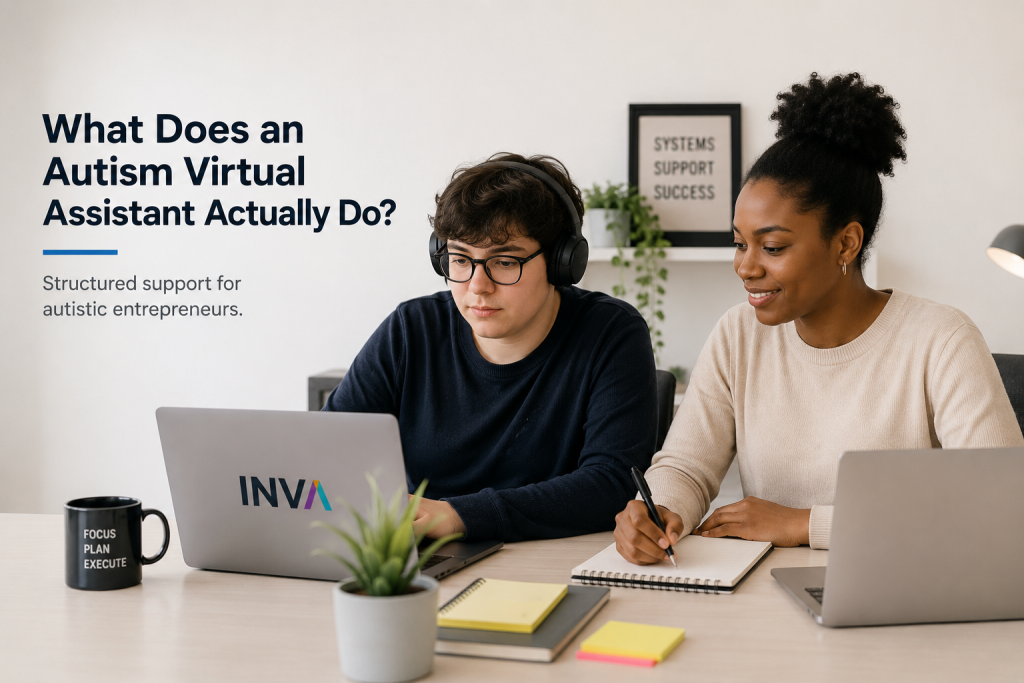
This article will discover what an autism virtual assistant does and how INVA practitioners help autistic entrepreneurs build structured systems, reduce cognitive load, and improve productivity, without asking anyone to mask, mold, or mimic neurotypical workflows.
Key Takeaways
- An autism virtual assistant provides structured operational support, not therapy or coaching.
- INVA practitioners function as AI-Augmented Operations Partners, combining human expertise with intelligent automation.
- Support is designed around the founder’s cognitive style, not standardized productivity templates.
- Outcomes include reduced overwhelm, predictable workflows, and sustainable execution.
- Every INVA completes the Mastering Inclusive Support certification before serving clients.
Defining the Role: More Than Administrative Help
An autism virtual assistant is not a therapist, clinician, or life coach. The role is operational. The practitioner builds and maintains the systems that allow an autistic founder to execute consistently, communicate clearly, and protect cognitive bandwidth for high-value work.
Furthermore, at INVA, this role is elevated further. Every practitioner operates as an AI-Augmented Operations Partner, integrating intelligent tools with structured human execution.
Instead, the best support does not ask autistic individuals to fit into someone else’s workflow. It creates a workflow designed to fit them.
How INVA Practitioners Help Autistic Entrepreneurs Build Structured Systems
Autistic founders often think in systems, patterns, and precision. The challenge is rarely strategy. Rather, It is the operational friction created by scattered tools, ambiguous communication, and reactive task management.
For example, INVA practitioners address this through:
| Operational Layer | What the INVA Builds |
|---|---|
| Workflow Architecture | Documented routines, SOPs, predictable task sequences |
| Communication Systems | Email triage, templated responses, decision logs |
| Knowledge Management | Centralized repositories replacing scattered notes |
| AI Integration | Automated research, summaries, drafts, and reporting |
| Accountability | Structured check-ins and progress tracking |
This is structured support, not generic virtual assistant services. The distinction matters.
Reducing Cognitive Load Through Predictable Operations
As a result, Cognitive load is the invisible tax on every autistic entrepreneur managing a business alone. Each unclear inbox, each context switch, each scattered file consumes processing capacity that could fuel deeper work.
An INVA practitioner reduces that load by:
- Centralizing information so decisions are not delayed by missing context.
- Standardizing communication so social ambiguity is minimized.
- Automating repetition so attention is reserved for strategic thinking.
- Documenting decisions so the founder is not the single point of memory.
Ultimately, the goal is operational clarity. When the system holds the structure, the founder is free to focus.
Improving Productivity Without Forcing Neurotypical Norms
However, conventional productivity advice often assumes uniform cognition. INVA rejects that premise. Productivity improves when the workflow is built around the individual’s strengths, sensory preferences, and energy patterns.
Because of this, the foundation of inclusive operational support. Practitioners are trained to design environments that respect deep-focus cycles, accommodate fluctuating capacity, and create distraction-resistant workflows.
The result is sustainable execution, not performative output.
Why INVA Practitioners Operate Differently
Every INVA completes the Mastering Inclusive Support certification and demonstrates proficiency in the AI-Augmented Operations Framework. This dual training produces operations partners who can:
- Implement structured systems across CRMs, project tools, and documentation platforms.
- Apply AI orchestration to reduce manual administrative work.
- Maintain professional standards across the United States Eastern Time Zone, Canada, Australia, and Africa.
- Support founders managing executive dysfunction, chronic illness, or fluctuating energy.
Learn more about what to look for in an inclusive virtual assistant organization before committing to any provider.
Conclusion: Build the System That Fits You
An autism virtual assistant, when trained properly, is not a task doer. The practitioner is execution infrastructure, the operational layer that converts scattered effort into predictable progress.
If the current operational structure is consuming more capacity than it returns, the next step is straightforward. Apply to work with an INVA practitioner and begin building workflows engineered around how you actually think, work, and execute.
The system should serve the founder. Not the other way around.
Frequently Asked Questions
1. Who can benefit from an autism virtual assistant?
An autism virtual assistant can benefit autistic entrepreneurs, freelancers, consultants, executives, and business owners who want more structure in their operations. The goal is not to change how someone thinks, but to build systems that support their natural working style.
2. How is an autism virtual assistant different from a traditional virtual assistant?
Traditional virtual assistants usually complete assigned tasks. An autism virtual assistant provides structured operational support by helping organize workflows, document processes, reduce cognitive load, and create predictable systems that improve long-term productivity.
3. Can an autism virtual assistant help reduce executive dysfunction?
Yes. While executive dysfunction is commonly associated with ADHD, many autistic entrepreneurs also experience challenges with task initiation, organization, switching between activities, or managing multiple priorities. Structured operational support can reduce these daily demands by creating reliable systems and routines.
4. What tasks can an autism virtual assistant manage?
Depending on the business, an autism virtual assistant may help manage email, calendars, documentation, CRM updates, project coordination, meeting preparation, research, workflow documentation, knowledge management, and AI-assisted administrative processes.
5. Why are structured systems important for autistic entrepreneurs?
Structured systems reduce unnecessary decision-making and make work more predictable. Clear workflows, documented processes, and organized information help reduce cognitive overload, allowing entrepreneurs to focus their energy on strategy, creativity, and business growth.
6. How do AI tools improve the support an autism virtual assistant provides?
AI helps automate repetitive administrative work such as research, meeting summaries, document organization, content preparation, and reporting. Combined with human judgment, AI allows operations partners to deliver faster, more consistent support while maintaining a personalized approach.
7. What makes an INVA Practitioner different from other virtual assistants?
INVA Practitioners are trained as AI-Augmented Operations Partners. They complete the Mastering Inclusive Support certification and learn to build neuro-inclusive operational systems that combine human expertise, structured workflows, and intelligent AI tools to support sustainable business growth.
8. Is an autism virtual assistant suitable for startups and small businesses?
Absolutely. Many autistic founders operate lean businesses where they wear multiple hats. An autism virtual assistant helps establish scalable systems early, making it easier to manage growth without increasing cognitive overload.
9. How do I choose the right autism virtual assistant?
Look for someone who understands neurodiversity, communicates clearly, builds documented systems rather than simply completing tasks, and can adapt their support to your preferred way of working. Experience with AI-powered operations and executive function support is also valuable.
10. How can I get started with an INVA Practitioner?
The first step is identifying the operational areas creating the most friction in your business. From there, INVA matches founders with practitioners trained to build structured workflows, reduce cognitive load, and provide AI-augmented operational support tailored to the founder’s working style.